



Private deployment is one of the first questions many enterprises ask when they begin evaluating an AI knowledge base. The concern is understandable. A knowledge base may contain product documents, internal policies, customer support history, implementation notes, contracts, process manuals, sales materials, and technical architecture. If employees use an AI assistant to search and summarize this information, leaders want to know where the data is stored, which model receives the prompt, who can view the logs, and whether the system can be operated inside a controlled environment.
But private deployment is not automatically the best answer for every company. It can reduce certain risks, satisfy internal compliance requirements, and give the organization more control over infrastructure. It can also increase cost, operational burden, upgrade complexity, and implementation time. The right question is not “is private deployment better?” The better question is “does the business case require private deployment strongly enough to justify the additional responsibility?”
An AI knowledge base platform such as FastGPT should be evaluated through that practical lens. The value of the system is not only that it can answer questions. The value is that it helps the company turn approved knowledge into a controlled service: searchable, traceable, permission-aware, and useful in real workflows. Private deployment is one possible operating model for that service. It makes sense when control and data boundaries are central to the project, but it should be chosen with a clear view of tradeoffs.
What Private Deployment Actually Means
Private deployment means the knowledge base application is operated in an environment controlled by the enterprise or its trusted infrastructure provider. Depending on the implementation, that environment may be an internal data center, a private cloud, a dedicated virtual private cloud, or a restricted network connected to existing enterprise systems. The main idea is that core application services, knowledge storage, retrieval components, and operational data are not simply running in a shared public SaaS environment.
However, the phrase “private deployment” can hide several different architecture choices. One company may self-host the application but still call an external model API. Another may keep documents inside the intranet but use a cloud-based embedding model. Another may deploy the knowledge base, vector database, embedding model, and large language model entirely within a private network. These are very different risk profiles. A serious evaluation should define exactly which components are private, which components call external services, and what data is sent across each boundary.
This matters because many AI risk conversations become too vague. A project owner may say “we need private deployment” when the real requirement is “our internal documents cannot leave the company network.” Another may say “we need local models” when the real requirement is “prompts and retrieved context must not be stored by an external provider.” The solution should match the requirement. Otherwise, the company may overbuild infrastructure while leaving the actual risk unresolved.
When Private Deployment Makes Business Sense
Private deployment makes the most sense when the knowledge base will contain sensitive or regulated information. Examples include financial data, healthcare-related materials, legal work product, confidential customer implementation documents, internal security procedures, proprietary research, government or public-sector content, and employee information. In these cases, leaders may need stronger control over storage, network access, logs, backups, and model calls.
It also makes sense when the AI assistant must connect to internal systems that are not exposed to the public internet. Many enterprise knowledge projects eventually move beyond Q&A. The assistant may need to help employees navigate OA workflows, retrieve CRM context, summarize support tickets, prepare procurement requests, or call internal APIs. If those systems live inside the intranet, a private deployment can simplify network architecture and reduce the need for sensitive connectors crossing external boundaries.
Another reason is customer or industry trust. Some companies sell to customers who ask strict questions about data residency, deployment topology, access control, audit logs, and vendor operations. If the AI knowledge base is part of a customer-facing service, a private or controlled deployment can become a commercial requirement. In these cases, deployment mode is not only a technical choice. It can affect procurement, sales cycles, and enterprise acceptance.
When Private Deployment May Be Overkill
Private deployment is less compelling when the use case is low-risk, the documents are already public or non-sensitive, the expected user base is small, and the organization has limited operations capacity. For example, a marketing team that wants an assistant for public website content and general product FAQs may not need a fully private deployment at the start. A small team running an internal pilot with non-confidential documents may be better served by moving quickly, learning from usage, and hardening the system later if the project proves valuable.
Private deployment can also be overkill when the company has not yet solved knowledge ownership. If no one knows which documents are current, who maintains them, or which answers are approved, moving the system into a private environment will not fix the core problem. A private but poorly governed knowledge base can still produce outdated or incorrect answers. Security architecture protects boundaries; it does not create high-quality knowledge by itself.
There is also a talent question. Self-hosting requires people who can operate the application, monitor services, manage upgrades, secure the environment, handle backups, troubleshoot failures, and coordinate with business owners. If the company does not have that capacity, private deployment may create more fragility than safety. In that case, the team should consider a phased approach: prove the use case first, then move to a stricter deployment model when the business value and operating ownership are clear.
The Cost Categories Leaders Should Compare
The visible cost of private deployment is infrastructure: servers, storage, network, databases, model runtime, monitoring, and backup capacity. But the bigger cost is often operational. Someone must install the system, configure it, secure it, test it, upgrade it, and respond when it behaves unexpectedly. If local models are used, the company may also need GPU resources, model optimization, inference monitoring, and capacity planning.
There are also implementation costs around document pipelines. Enterprise knowledge bases need parsing, chunking, indexing, metadata handling, retrieval tuning, citation display, and quality evaluation. These tasks exist in both SaaS and private deployment models, but private deployment gives the enterprise more responsibility for the environment around them. A failed ingestion job, slow retrieval response, or storage issue becomes an internal operations issue.
The third cost category is governance. Private deployment often comes with higher expectations from security, compliance, and IT teams. They may ask for role-based access control, network restrictions, audit trails, backup plans, secret management, change logs, and incident response procedures. These requirements are reasonable, but they take time. The team should include them in the project plan instead of treating private deployment as a simple installation option.
Security Is More Than Where the Server Runs
One common mistake is assuming that private deployment automatically makes an AI knowledge base secure. Location matters, but it is only one layer. A secure knowledge base also needs permission design, document ownership, model boundary control, prompt and tool safety, log management, user authentication, administrator controls, and review procedures. If all employees can search all documents, the system may leak sensitive knowledge internally even if it never leaves the company network.
Permission design should start with business roles. Which teams can upload knowledge? Which users can query each knowledge base? Can one department see another department’s documents? Are customer-specific materials isolated? Can administrators inspect all logs? Should some answers require approval before being sent externally? These questions are often more important than the server location because they shape how knowledge flows through the organization.
Model boundaries also matter. If the knowledge base uses external model APIs, the team must understand what content is sent in prompts, whether retrieved context is included, how logs are handled, and whether data is retained. If the system uses local models, the team must evaluate answer quality, latency, hardware cost, and maintenance. There is no universal answer. The secure design is the one that matches the company’s actual risk profile and operating capability.
Private Deployment Should Still Be Measured Like a Business Project
A private AI knowledge base should not be approved only because it sounds safer. It should be measured against business outcomes. If the use case is customer support, measure first-response time, escalation rate, answer consistency, and self-service resolution. If the use case is HR, measure repeated policy questions, employee satisfaction, and reduction in manual replies. If the use case is OA process guidance, measure fewer process mistakes, faster request preparation, and reduced internal support load.
Quality metrics matter too. The team should track whether the assistant retrieves the right source, whether citations are useful, whether it refuses unsupported questions, and whether users report bad answers. These metrics are especially important in private deployments because the company is taking on more ownership. The project should prove that the extra control produces dependable value, not just a more complex architecture.
A practical pilot can make the decision clearer. Start with one department, one knowledge domain, and a defined question set. Test the assistant with real user questions. Review failures weekly. Confirm whether private deployment meaningfully reduces risk for this use case. Then decide whether to expand. This avoids the trap of building a large private infrastructure before the team knows which workflows will actually benefit.
How FastGPT Fits into the Decision
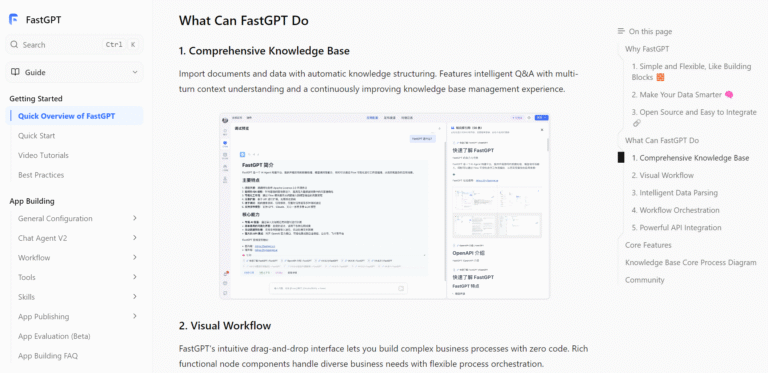
FastGPT should be considered as an application layer for building knowledge-based AI experiences, not merely as a generic model wrapper. The important evaluation areas are knowledge base management, retrieval behavior, workflow design, citation support, permission needs, and deployment compatibility. Teams should ask whether the platform helps them move from documents to usable applications with less custom engineering.
The FastGPT official documentation is a useful place to understand the product structure and implementation concepts. During evaluation, teams should test the exact deployment pattern they care about. If the requirement is intranet-only knowledge access, test that architecture. If the requirement is local model usage, test answer quality and latency. If the requirement is controlled workflow automation, test permissions and failure handling. Do not assume that a demo environment proves production readiness.
The strongest FastGPT evaluation will combine technical and organizational questions. Can business teams maintain knowledge without constant engineering support? Can administrators review retrieval quality? Can the system cite sources in a way users trust? Can the deployment model meet internal security requirements? Can the assistant support workflows without replacing systems of record? These questions reveal whether the platform fits the company’s operating model.
A Decision Framework for Self-Hosting
Before choosing private deployment, leaders can use a simple decision framework. First, classify the data. Is it public, internal, confidential, regulated, customer-specific, or operationally sensitive? Second, classify the users. Will the assistant serve a small internal team, the whole company, external customers, or partners? Third, classify the actions. Will the assistant only answer questions, or will it trigger workflows and call internal systems? Fourth, classify the operating capability. Does the company have the people and processes to run the system reliably?
If the data is sensitive, the user base is broad, the assistant connects to internal systems, and the company has strong operations capability, private deployment may be worth the investment. If the data is low-risk, the use case is experimental, the team is small, and operations capacity is limited, a lighter deployment model may be more practical. If the answer is mixed, the company can phase the rollout: begin with a narrow use case, validate value, then tighten deployment and governance as adoption grows.
The decision should also include exit and upgrade planning. How will the system be updated? How will knowledge be exported or backed up? How will model changes be tested? How will security patches be applied? How will usage be monitored? Private deployment gives more control, but it also makes these responsibilities more visible. A company should choose it with open eyes.
Final Takeaway
A private AI knowledge base is worth it when control, compliance, data boundaries, and internal integration are central to the business case. It is less useful when the company is still testing a low-risk idea, lacks knowledge ownership, or cannot support the operational responsibilities of self-hosting. The decision should be based on risk, value, and maintainability, not on a general belief that private is always better.
For enterprises, the winning approach is usually pragmatic. Start with the knowledge workflows that matter most. Define the data boundary clearly. Test retrieval quality and citation behavior. Decide who owns the content. Measure business impact. Then choose the deployment model that supports the work without adding unnecessary drag. Private deployment can be a strong choice, but only when it serves a real operational need. The goal is not to build the most locked-down system possible. The goal is to make enterprise knowledge usable, trustworthy, and governed in the environment where the business can actually maintain it.
