



Introduction
Playgrounds are more than recreational spaces; they are essential environments where children develop physically, socially, emotionally, and cognitively. In recent years, there has been a growing emphasis on creating spaces that allow all children regardless of ability to play together without barriers. This approach is known as inclusive design, and it has transformed how modern play areas are planned and built.
Inclusive playground equipment is specifically designed to remove physical, sensory, and cognitive barriers so that children of all abilities can participate in shared play experiences. Unlike traditional playgrounds that may unintentionally exclude certain users, inclusive spaces focus on accessibility, engagement, and equal opportunity for interaction. The goal is not only access but meaningful participation where every child can engage in play in their own way.
What Is Inclusive Playground Equipment?
Inclusive playground equipment refers to structures and play elements designed to accommodate children with diverse physical, sensory, and cognitive abilities. These systems ensure that children who use wheelchairs, have mobility challenges, sensory sensitivities, or developmental differences can all access and enjoy the same play environment.
A key principle behind inclusive design is universal usability. This means equipment should be flexible enough to be used in different ways, allowing children to interact based on their individual needs and abilities. For example, a climbing structure may include ramps for wheelchair users, tactile panels for sensory engagement, and traditional climbing paths for more physically active children.
Research highlights that inclusive playgrounds go beyond basic accessibility by ensuring that children of all abilities can interact together in meaningful ways rather than being separated into different areas
Core Principles of Inclusive Playground Design
Inclusive playgrounds are built on universal design principles that prioritize fairness, flexibility, and ease of use. These principles ensure that the environment supports participation for everyone.
One of the most important principles is equitable use, meaning that all children should be able to access and enjoy the same equipment. Another is flexibility in use, which allows different ways of interacting with the same structure. Simplicity and intuitive design also play a major role, making it easier for children of all cognitive levels to understand how equipment works.
Inclusive playgrounds are also designed with sensory diversity in mind, ensuring that children who are visually, hearing, or sensory impaired can still engage through touch, sound, or movement-based play elements
Key Features of Inclusive Playground Equipment
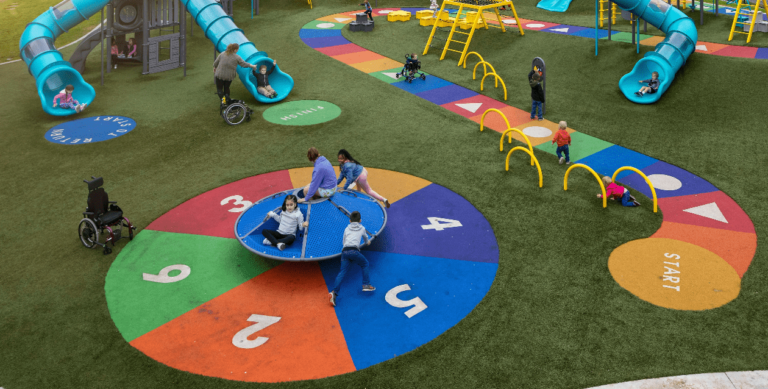
Modern inclusive playgrounds incorporate a wide variety of features designed to support different abilities and play styles. Some of the most common elements include Ramps and Wide Access PathsRamps replace stairs to allow wheelchair users and children with mobility aids to access elevated platforms safely. Wide pathways also ensure smooth movement throughout the play area.Ground-Level Play Elements
Ground-level equipment ensures that children who cannot climb or reach elevated structures can still participate fully. These may include interactive panels, sensory boards, and musical play stations.Adaptive Swings and Spinners
Specially designed swings allow children with physical disabilities to enjoy motion-based play. Similarly, inclusive carousels and spinning equipment allow group participation regardless of ability.Sensory Play Features
Textured panels, sound-based instruments, and visual stimulation elements help children with sensory processing differences engage comfortably while also supporting cognitive development.Social and Cooperative Play Zones
Inclusive playgrounds often include shared spaces where children can interact, collaborate, and build friendships through cooperative games and group activities.These features work together to ensure that children are not only present in the same space but actively engaged in shared experiences.
Types of Inclusive Playground Equipment
Inclusive playground equipment can be categorized based on its function and play value.Physical Play Equipment includes climbing structures, slides with ramp access, and motion-based systems that encourage movement and coordination.Sensory Play Equipment includes musical panels, tactile walls, and visual stimulation features designed to engage multiple senses simultaneously.Social Play Equipment focuses on group interaction, such as cooperative games, shared swings, or communication boards that encourage teamwork.Adaptive Equipment is specifically designed for children with disabilities, ensuring safe and comfortable participation in play activities.
This combination of equipment ensures that every child can find something enjoyable and meaningful within the same environment.
Benefits of Inclusive Playground Equipment
Inclusive playgrounds provide significant benefits not only for children with disabilities but for all users.
One of the most important benefits is social inclusion. When children of different abilities play together, they develop empathy, understanding, and stronger social bonds. This helps create more accepting communities over time.
Another key benefit is physical development. Inclusive equipment encourages movement, balance, and coordination, which are essential for healthy growth. Even children with limited mobility can engage in adapted physical activities that support development.Cognitive and emotional development is also enhanced through problem-solving activities, sensory engagement, and imaginative play. These experiences help children build confidence and independence.Studies show that inclusive playgrounds promote cooperation, reduce social isolation, and improve overall well-being for children of all abilities
Importance of Accessibility in Play Spaces
Accessibility is the foundation of inclusive playground design. Without proper access routes, even the most advanced equipment becomes unusable for some children. Features such as smooth surfacing, barrier-free entry points, and accessible seating areas ensure that all users can move freely throughout the playground.However, accessibility alone is not enough. True inclusivity ensures that once children enter the space, they can fully participate in play activities. This distinction is important because inclusive design focuses on engagement rather than just entry.
Design Challenges and Considerations
Creating inclusive playgrounds involves careful planning and consideration of multiple factors. One challenge is balancing different types of play needs within a single space. Designers must ensure that equipment is stimulating without being overwhelming.Safety is another major consideration. Surfaces must be impact-resistant, equipment must be regularly inspected, and designs must comply with safety standards to prevent injuries.Cost can also be a limiting factor, as inclusive playground equipment often requires specialized materials and engineering. However, the long-term benefits in terms of community value and child development often outweigh initial investment costs.
Role of Inclusive Play in Child Development
Play is a critical part of childhood development. It supports brain growth, emotional regulation, physical strength, and social learning. Inclusive playgrounds enhance these benefits by ensuring that every child has equal opportunity to participate.
When children engage in shared play, they learn cooperation, communication, and problem-solving skills. These experiences are essential for building confidence and preparing for real-world social interactions.Inclusive environments also support neurodiverse children by providing sensory-friendly and adaptable spaces that meet their unique needs.
Future Trends in Inclusive Playground Design
The future of playground design is moving toward even greater inclusivity and innovation. Designers are increasingly integrating smart technology, interactive digital elements, and modular equipment that can be adapted over time.Sustainability is also becoming an important focus, with eco-friendly materials and energy-efficient designs being incorporated into new playgrounds.
Another emerging trend is community-centered design, where playgrounds are built based on feedback from local families and children to better reflect real user needs.
Conclusion
Inclusive playground equipment represents a significant advancement in how play spaces are designed and experienced. By focusing on accessibility, engagement, and equality, these environments ensure that children of all abilities can play together, learn from each other, and grow in meaningful ways.
The value of inclusive design goes beyond physical structures; it fosters empathy, strengthens communities, and supports holistic child development. As awareness continues to grow, inclusive playgrounds are becoming an essential part of modern public spaces.Ultimately, inclusive playground equipment is not just about building better play areas; it is about building a more inclusive and connected society where every child has the opportunity to play, explore, and belong.
