



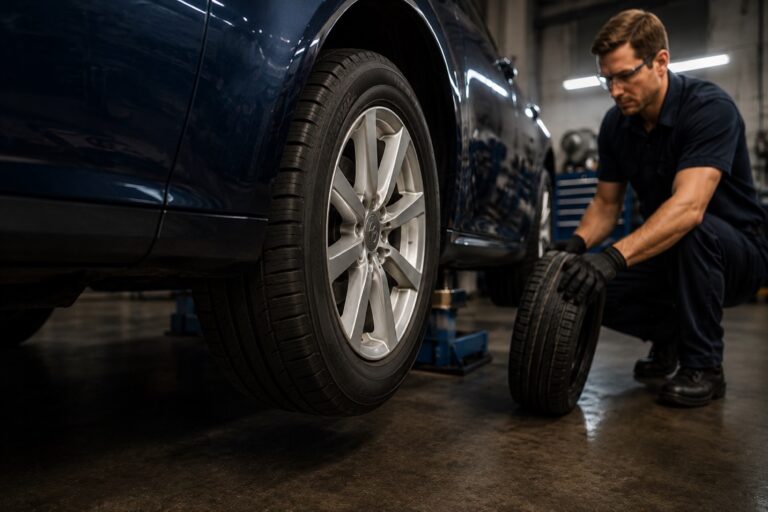
Run flat tires can sometimes be repaired but only under very specific conditions. Whether yours qualifies depends on how far you drove after the pressure dropped, where the damage is located, and what your tire manufacturer’s policy actually allows. Here’s how to tell the difference.
How Run Flat Tires Work
To understand why repair is complicated, you need to know what makes run flat tires different from standard tires. There are two main designs:
- Self-supporting run flats: The most common type. Reinforced sidewalls, made from a stiffer, thicker rubber compound, carry the weight of the vehicle even when air pressure drops to zero. You’ll find these on BMW, Mercedes-Benz, and many newer luxury and performance vehicles.
- Support ring systems: A hard ring inside the wheel supports the vehicle’s weight when pressure is lost. Less common, but used on some military and specialist vehicles.
In both cases, the design that keeps you moving after a puncture is also what makes repair uncertain. When a run flat operates at zero or near-zero pressure, its internal structure, the very reinforcements that held the car up, can be permanently damaged. That damage is often invisible from the outside, which is the core problem with repair decisions.
Most run flat tires are rated for continued driving at up to 50 mph for up to 50 miles after a puncture. That’s enough to reach a repair facility, not enough to keep running indefinitely. According to Tire Rack, even if you stay within those limits, driving on a run flat at low or zero pressure can permanently damage its internal structure.
The Short Answer: It Depends on These Three Factors
A run flat tire might be repairable if all three of the following are true:
- The damage is in the center tread area, not the sidewall or shoulder, and the puncture is no larger than ¼ inch (6mm)
- You didn’t drive on it while flat, or drove only a minimal distance before reaching a service provider
- Your tire manufacturer’s policy permits repair — and this varies significantly by brand
If any one of those three conditions fails, replacement is the only safe option. This is not a conservative interpretation, it reflects the actual positions of the U.S. Tire Manufacturers Association (USTMA) and most major tire brands.
What Tire Manufacturers Actually Say About Run Flat Repair
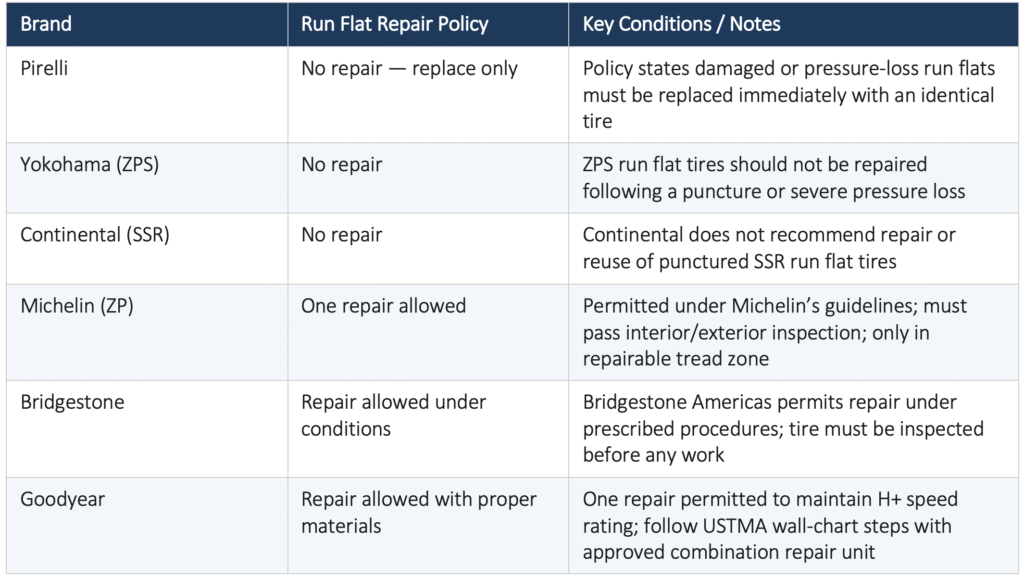
There is no industry-wide consensus on run flat repair. Each manufacturer sets its own policy, and they differ substantially:
Source: Automotive Fleet, Tire Rack, Sparky X Run Flat Repair Guide (2026), USTMA TISB Vol. 47 No. 3 (July 2024)
The key takeaway: even brands that permit repair only do so after a thorough interior and exterior inspection by a trained technician. No responsible shop should patch a run flat without first demounting and inspecting it from the inside.
The Hidden Damage Problem: Why Inspection Always Comes First
This is the part most drivers don’t know: run flat tire damage from driving at zero pressure is often invisible on the surface. The reinforced sidewall compound that holds the car up can delaminate, crack, or weaken internally and none of that shows up when you look at the outside of the tire.
According to Continental’s technical services team, the thick stiff compound in run flat sidewalls is typically not the same material visible on the tire’s interior or exterior. If there’s separation between those layers, neither the dealer nor the customer may know about it, until the tire has a second incident and the run flat fails to perform as designed.
This is why Tire Rack and USTMA both require that any run flat involved in a low or zero-pressure event be demounted and inspected by a tire service professional before any repair or reuse decision is made. The inspection is not optional, it’s the basis for the entire repair decision.
When a Run Flat Tire Cannot Be Repaired
Replace your run flat tire without hesitation if any of the following apply:
- The puncture is in the sidewall or shoulder area (never repairable on any tire)
- The damage is larger than ¼ inch (6mm) in diameter
- You drove the tire at zero or severely low pressure beyond the manufacturer’s recommended distance
- Your tire manufacturer’s policy does not permit repair for that specific model (e.g., Pirelli, Yokohama ZPS, Continental SSR)
- The interior inspection reveals internal damage: liner abrasion, delamination, belt separation, or sidewall cracking
- Visible evidence of sidewall distortion or a secondary bulge
- The tire was exposed to tire repair sealant (most brands prohibit repair afterward)
- Tread depth is below 2/32 inch — not worth repairing regardless
When a Run Flat Repair May Be Possible
A qualified technician may be able to repair your run flat if all of the following conditions are met:
- The puncture is in the center tread area — at least ½ inch away from the shoulder
- The hole is no larger than ¼ inch (6mm)
- You drove only a minimal distance at reduced speed after the pressure dropped — or not at all
- Your tire brand’s policy permits repair (verify with the manufacturer or a certified technician)
- The tire passes a full interior and exterior inspection after being demounted
- The repair is performed using a USTMA-approved combination plug-patch unit — not a plug alone
Even when all conditions are met, some manufacturers cap the number of repairs a run flat can receive. Michelin, for example, allows one repair on its Zero Pressure tires. After that, replacement is required.
GT Radial Run Flat Tires: What You Need to Know
GT Radial’s run flat offering the SportActive RunFlat — is a UHP tire with reinforced sidewall construction designed for continued mobility after pressure loss. As with all run flat performance tires, repair decisions should follow the three-factor framework above: damage location, driven distance, and manufacturer guidelines.
For current repair policies specific to the SportActive RunFlat, consult the fitment guide at gtradial.com or speak with an authorized GT Radial dealer. Never assume a repair is safe without a formal inspection that applies to any brand, GT Radial included.
Frequently Asked Questions
Can you plug a run flat tire?
A plug alone is not an acceptable repair for any tire, including run flats per USTMA guidelines. A plug does not seal the inner liner or reinforce the damaged area. If a run flat can be repaired at all, the correct method is a combination plug-patch unit installed by a trained technician after the tire has been demounted and inspected.
Can you repair a run flat tire after driving on it flat?
In most cases, no. Driving on a run flat at zero or severely low pressure compromises the internal reinforcements that make the tire function. That damage is frequently invisible externally but can cause catastrophic failure if the tire is repaired and put back into service. Tire Rack does not repair run flat tires driven in a severely underinflated or zero-pressure condition, and most major manufacturers take the same position.
How much does it cost to replace a run flat tire?
Run flat tires typically cost 30–50% more than equivalent conventional tires due to their reinforced construction. Depending on the vehicle and tire size, a single run flat replacement can range from $150 to $400 or more. That cost is one reason drivers explore repair options, but the correct answer is always safety first: replace when in doubt.
Do all car manufacturers allow run flat tire repairs?
No. Some vehicle manufacturers explicitly prohibit repair of the run flat tires fitted to their cars, regardless of what the tire brand’s policy says. BMW’s owner’s manual, for example, recommends against repairing OEM run flat tires even when the tire manufacturer (such as Michelin or Bridgestone) allows it. Always check both the tire manufacturer’s policy and your vehicle manufacturer’s owner’s manual.
What happens if you mix run flat and standard tires?
Mixing run flat and standard tires on the same vehicle compromises handling, braking, and stability. Run flats are significantly stiffer than standard tires, and combining them creates unpredictable handling differences between the axles, particularly during cornering or emergency maneuvers. Most manufacturers require all four tires to match type for this reason.
Is a repaired run flat tire safe at highway speeds?
Only if the repair was performed correctly under the right conditions. Continental notes that some manufacturers allow multiple repairs but with a reduced speed rating after each one, meaning a tire that was once speed-rated for 130+ mph may no longer be after a proper repair. Always confirm the post-repair speed rating with the technician and verify it meets your vehicle’s requirements.
The Bottom Line on Run Flat Tire Repair
Run flat tires can be repaired, but only under a narrow set of conditions, and only after a professional inspection that most drivers skip. The core risk is invisible internal damage: the reinforced sidewalls that kept your car moving after a puncture may be compromised in ways no visual check can confirm. When your tire manufacturer prohibits repair, or when the inspection raises any doubt, replacement is the only responsible choice.
Before making any decision, check your tire brand’s specific repair policy and your vehicle owner’s manual. Then get the tire inspected by a trained technician, not just glanced at from the outside.
Find an authorized GT Radial dealer near you at gtradial.com for expert fitment advice and run flat tire support.
