



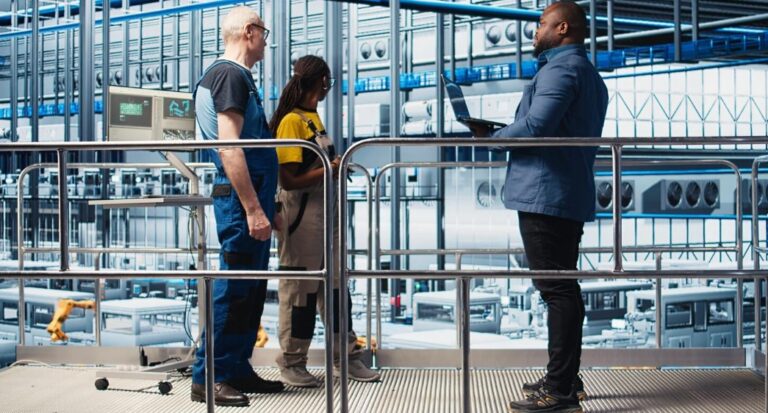
Most industrial facilities that rely on refrigeration systems treat climate as background context — a factor to acknowledge during initial design, then largely set aside once a system is running. That approach works reasonably well in regions where seasonal temperature variation stays within a predictable, moderate range. In Utah, it does not work at all.
Utah’s climate is genuinely unusual. The state sits at high elevation with a semi-arid interior basin, surrounded by mountain ranges that create localized weather effects. Temperatures can reach well above 100°F in summer valley heat and drop far below freezing across winter nights — sometimes within the same week during shoulder seasons. For any facility running continuous refrigeration processes, this range is not just uncomfortable. It is operationally significant. The engineering decisions that determine whether a refrigeration system holds temperature reliably in July are often the same decisions that determine whether it runs efficiently or fails entirely in January.
Facilities across the state — food processing plants, cold storage warehouses, pharmaceutical manufacturers, agricultural distribution centers — have learned this through direct experience. What looks like a straightforward refrigeration challenge on paper becomes substantially more demanding once the actual operating environment is accounted for in full.
Why Utah’s Climate Creates Compounding Engineering Constraints
When engineers approach industrial refrigeration engineering utah projects, the primary challenge is not designing for one difficult condition. It is designing for several conflicting conditions that a single system must handle without being optimized exclusively for any of them. This is a different kind of engineering problem than most states present, and it shapes every major decision in the design phase.
A system designed to manage peak summer heat loads efficiently will typically run at a fraction of its capacity during winter. Conversely, a system tuned for cold-weather efficiency may struggle to maintain adequate condensing performance during extended summer heat. In most states, this trade-off is real but manageable. In Utah, the spread between summer peaks and winter lows is wide enough that the trade-off becomes a genuine design conflict.
Engineers working in this environment must make deliberate choices about which conditions take priority, where redundancy is necessary, and which components need to be sized or selected to accommodate range rather than optimized for a single condition. These are not minor calibration decisions. They affect capital cost, operating cost, long-term reliability, and the risk profile of the entire refrigeration system.
For facilities considering new systems or evaluating existing infrastructure, working with engineers who specifically understand industrial refrigeration engineering utah conditions provides a practical advantage — not as a credential, but as a matter of applied regional knowledge that affects real outcomes.
The Problem With Standard Design Assumptions
Most refrigeration system design draws on industry standards and manufacturer specifications that assume a general operating environment. These standards are not wrong, but they are written around typical conditions in temperate or coastal climates where temperature variation is less extreme. When applied directly to Utah projects without adjustment, they tend to produce systems that perform adequately under moderate conditions and struggle at the extremes.
The issue shows up most clearly in condenser sizing and compressor selection. Standard sizing tables use ambient temperature assumptions that reflect national averages. Utah’s summer ambient temperatures in valley locations frequently exceed those assumptions by a meaningful margin. When a condenser is undersized for actual peak ambient conditions, the system cannot shed heat efficiently. Condensing pressure rises, compressors work harder, and the system either trips on safety controls or runs continuously without reaching setpoint.
The inverse problem occurs in winter. When ambient temperatures drop sharply, head pressure falls below the range the system was designed to operate within, and without appropriate head pressure control, liquid refrigerant floods back into the compressor — a condition that can cause rapid mechanical failure. Standard designs in milder climates rarely need to address this. In Utah, it is a routine engineering consideration.
Elevation as a Silent Load Variable
Utah’s elevation compounds temperature-related challenges in ways that are easy to underestimate during early project planning. Much of the state’s industrial activity occurs at elevations significantly higher than sea level, and elevation affects refrigeration system performance in specific, measurable ways that are not always reflected in baseline engineering calculations.
At higher elevations, air density decreases. For air-cooled refrigeration systems, lower air density means reduced heat transfer capacity from condensers. A condenser that performs as specified at sea level will reject less heat at elevation, which means the effective cooling capacity of the system is lower than its nameplate rating suggests. In practical terms, a facility at high elevation running an air-cooled system must account for this performance gap or risk building in a capacity deficit from the start.
Refrigerant Behavior at Altitude
Elevation also affects refrigerant behavior in ways that interact with temperature variability. Refrigerant boiling points and pressure-temperature relationships are fixed by physics, but the surrounding environment that the system must work against changes with elevation. When ambient conditions are already pushing the system toward its operational limits in summer heat, the reduced convective heat rejection capacity caused by lower air density can tip a marginally designed system into unreliable operation.
This is particularly relevant for facilities that have expanded operations over time, adding refrigeration load to systems that were originally designed for lower capacity. A system that handled original loads adequately may not have the headroom to manage increased demand under high-elevation, high-temperature conditions simultaneously. Expansion projects in Utah require a more thorough baseline assessment than similar projects in lower-elevation states.
Seasonal Transitions and System Stress
One of the less discussed but practically significant aspects of Utah’s climate is the speed and unpredictability of seasonal transitions. Spring and fall in much of the state are not gradual progressions between stable seasons. They are periods of frequent, sometimes rapid shifts — a week of warm temperatures followed by a late snow event, or an early heat spike in May before ambient conditions stabilize for summer.
For industrial refrigeration systems, rapid ambient transitions create specific operational stress. Systems running in cold-weather mode may need to shift operating parameters quickly as temperatures rise. If head pressure controls, variable speed drives, or condenser fan staging are not properly configured for rapid response, the system may lag behind changing conditions and operate inefficiently or outside its intended parameters for extended periods.
Control System Design for Variable Conditions
Managing seasonal transitions well is largely a controls engineering challenge. The physical components of a refrigeration system can be appropriately sized, but if the control logic is not designed to respond to wide ambient variation, the mechanical components will not operate as intended. In Utah, control system design is not a secondary concern — it is as important as equipment selection.
Effective control systems for this environment need to handle multiple operating modes and transition between them smoothly based on real-time ambient and system conditions. This includes managing condenser fan staging across a wide temperature range, maintaining stable suction pressure as load and ambient conditions change, and protecting compressors during both high-head and low-head pressure scenarios. According to the American Society of Heating, Refrigerating and Air-Conditioning Engineers, system control sequences for varying ambient conditions are among the most important design elements in ensuring long-term refrigeration reliability, yet they are frequently underspecified in standard project documentation.
Water Availability and Evaporative Cooling Limits
Utah is classified as an arid to semi-arid state, and water availability affects refrigeration system design choices in ways that differ from more humid or water-rich regions. Evaporative condensers and cooling towers — both commonly used in large industrial refrigeration applications — require a reliable water supply and must manage evaporative losses carefully. In Utah, water costs and availability constraints influence how practical these systems are over the long term.
Facilities that might default to evaporative cooling equipment in other states may find that dry coolers or hybrid systems make more operational and economic sense in Utah, particularly in locations where water costs are high or where water-use restrictions could affect operations during drought conditions. This is a design decision that reaches beyond engineering preference into operational resilience planning.
Balancing Efficiency With Long-Term Risk
Evaporative systems offer significant efficiency advantages under the right conditions, and in Utah’s dry climate, they can perform very well during peak summer heat precisely because dry bulb temperatures are high but wet bulb temperatures remain relatively low. The challenge is that efficiency gains during summer operation need to be weighed against the operational and regulatory risk that water constraints represent over a multi-decade facility life span. Industrial refrigeration engineering in Utah increasingly involves this kind of long-range scenario planning as part of the initial design process, rather than treating water supply as a fixed assumption.
The Case for Region-Specific Engineering Expertise
Industrial refrigeration systems are long-lived assets. A system installed today will likely be in operation for several decades, across hundreds of seasonal cycles, under operating conditions that vary more than most facility managers anticipate at project inception. Getting the engineering right from the beginning — accounting for Utah’s actual climate range, elevation effects, water constraints, and transition period volatility — is not a luxury consideration. It is a direct determinant of lifecycle cost, reliability, and the risk of unplanned downtime.
General refrigeration engineering competence is not enough in this environment. The specific knowledge required to make sound design decisions in Utah comes from working within this climate repeatedly, understanding where standard assumptions break down, and building that knowledge into project decisions at every phase — from initial load calculations through equipment selection, controls design, and commissioning.
Conclusion
Utah presents a refrigeration engineering environment that is more demanding than its geography might initially suggest. The combination of extreme temperature range, significant elevation, arid conditions, and unpredictable seasonal transitions creates a set of engineering constraints that cannot be addressed by applying standard design approaches developed for more moderate climates.
Facilities that invest in engineering work grounded in regional knowledge — systems sized and controlled for the actual range of conditions they will face, not just the average — consistently outperform those that do not. They experience fewer unplanned failures, lower long-term operating costs, and greater confidence that the system will hold performance through whatever the Utah climate delivers in a given year.
For operations that depend on continuous, reliable refrigeration, that difference in engineering approach is not abstract. It shows up directly in uptime, energy consumption, maintenance frequency, and the long-term serviceability of a major capital investment. In a state where the climate does not cooperate with average assumptions, average engineering carries real operational risk.
