



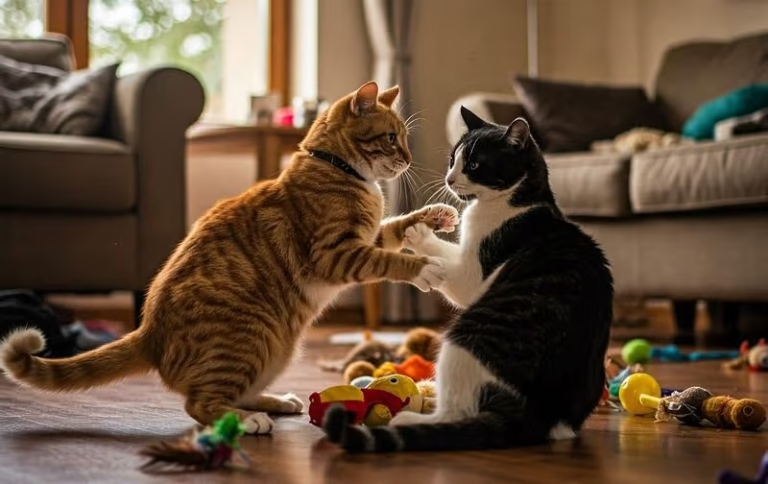
Millions of households are home to more than one cat, yet the science of how cats actually relate to one another is poorly understood by most owners. The result is avoidable conflict, chronic stress, and households that are far less harmonious than they could be. The good news is that feline social dynamics are well-researched, and the interventions that produce peaceful multi-cat households are practical, accessible, and highly effective when applied correctly.
Why Cats Struggle to Share Space
Understanding feline conflict starts with understanding feline nature. Unlike dogs, cats are solitary hunters whose survival historically depended on exclusive control of a feeding territory. A new cat entering an established territory is not experienced as an opportunity for friendship — it is experienced as a threat. This territorial instinct does not disappear in domestic settings, and ignoring it is the most common mistake multi-cat owners make.
Conflict in multi-cat households is often subtler than owners realise. Direct fighting is the visible extreme, but far more common is low-level intimidation: staring, blocking access to resources, and subtle postural dominance that forces one cat into a state of chronic low-grade stress without a single obvious confrontation taking place.
The Resource Formula
Resource competition drives most multi-cat tension. The guiding principle is simple: provide one resource per cat, plus one extra. This applies to food stations, water bowls, litter boxes, scratching posts, resting spots, and hiding spaces. When cats must compete for access to these essentials, stress escalates. When resources are abundant and spatially distributed throughout the home, competition reduces and peaceful coexistence becomes far more achievable.
Vertical space is equally important. Cat trees, shelving, and elevated walkways multiply the effective territory available within a fixed floor plan, allowing cats to establish distinct zones and retreat from one another without forced proximity.
Introduction Protocols That Actually Work
The single greatest predictor of long-term harmony in a multi-cat household is how the initial introduction is managed. Rushing cats into shared space virtually guarantees conflict. A structured introduction — beginning with complete physical separation, progressing through scent exchange, then visual contact through a barrier, and finally supervised shared access — gives each cat time to process the newcomer’s presence without the threat of direct confrontation.
Maintaining parasite prevention for all cats in the household with a product like Neoveon Plus Cat is a practical part of responsible multi-cat ownership, protecting every member of the household from the cross-transmission risks that come with animals sharing space.
Ongoing Management
Introductions are a beginning, not an endpoint. Multi-cat households benefit from ongoing attention to group dynamics, with owners watching for signs of tension and responding early. As the ASPCA advises, providing multiple identical resources, additional perches, and separate feeding areas are among the most reliable tools for reducing competition and maintaining household harmony over the long term. With the right environment and management, multi-cat households can be places of genuine feline companionship — and that is very much worth working toward.
