



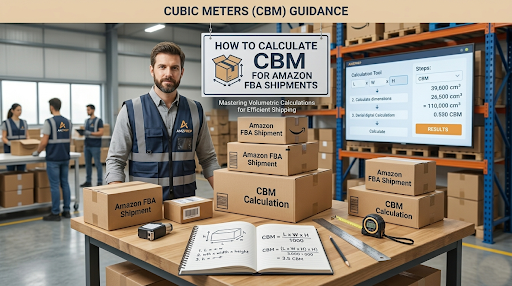
Shipping costs, carrier quotes, and freight decisions all come back to one number: volume. Most sellers know their product dimensions. Fewer know how to turn those dimensions into a figure their carrier actually uses to price a shipment.
That figure is CBM (cubic meters). Get it wrong and you underpay or overpay for freight. Get it right and you can compare quotes accurately, forecast costs, and ship without delays.
This article covers how to calculate the CBM on your shipments, how it connects to Amazon FBA requirements, and what to watch for before your inventory reaches a fulfillment center.
What CBM Means for Sellers
CBM stands for cubic meter. It is the standard unit of volume measurement used in international and domestic freight. Carriers use it to determine how much space your shipment occupies on a truck, container, or air pallet.
A CBM calculator converts the length, width, and height of your carton or multiple cartons into total cubic volume. That volume, combined with weight, determines whether your shipment is priced by dimensional weight or actual weight.
For Amazon FBA sellers, this matters at two points. First, when you book freight from your supplier or prep center to Amazon. Second, when you estimate whether your carton sizes meet Amazon FBA prep requirements during the packaging phase.
How to Calculate CBM
The formula is simple. Multiply the length, width, and height of a carton in centimeters, then divide by one million to convert to cubic meters.
CBM = (L x W x H) / 1,000,000
For a carton that is 50 cm x 40 cm x 30 cm:
50 x 40 x 30 = 60,000 cm³ 60,000 / 1,000,000 = 0.06 CBM
For multiple cartons, multiply the result by your carton count. If you have 100 cartons of the same size, your total shipment volume is 6 CBM.
Calculating cubic meters manually works for small shipments. For larger SKU counts or mixed carton sizes, a cube calculator for shipping removes the risk of input error and handles multiple line items at once.
A CBM shipping calculator like the one at AMZ Prep processes each carton dimension separately and returns both per-carton and total shipment volume in one pass. Using a cbm calculator for shipping is faster and reduces the chance of quoting a carrier on incorrect volume.
Why CBM Matters Before the Shipment Leaves Your Factory
Most sellers check CBM when they receive a freight quote. The better practice is to run a shipping CBM calculator before your cartons are packed.
Carton dimensions affect three things upstream of freight:
Carrier pricing
Carriers that use dimensional weight pricing will charge based on volume if it exceeds a weight threshold. Knowing your CBM before booking lets you negotiate or consolidate.
Container utilization
A shipment quoted at 5 CBM that actually measures 7 CBM when palletized can affect your container allocation. The gap comes from pallet overhang, dunnage, and stacking limits.
Amazon’s receiving windows
Amazon’s inbound requirements include limits on carton weight and size. A carton that exceeds those limits will be flagged at the receiving dock. That creates a return or a repack, both of which add cost and delay.
FBA Packaging Requirements and CBM Overlap
Amazon’s FBA packaging requirements are more specific than most sellers expect. The requirements cover carton dimensions, unit prep, labeling placement, and barcode readability. They also set weight limits per carton for standard and oversized items.
A carton that is too large by volume often also exceeds the weight limit. That is not a coincidence. Amazon’s amazon fba prep requirements are built around what warehouse associates can safely handle and scan without stopping at each unit. Oversized cartons slow receiving and are returned or assessed a fee.
Before building your master carton configuration, review the full amazon packaging requirements that apply to your product category. Requirements differ for poly-bagged items, bubble-wrapped products, multi-packs, and hazmat categories.
A cubic meter calculator used at the carton-design stage tells you whether your configuration fits within Amazon’s acceptable parameters before you commit to a packaging run. Changing carton dimensions after production is expensive. Catching a mismatch at the planning stage is not.
Common CBM Mistakes That Affect FBA Shipments
Using inner carton dimensions instead of outer
Carriers and Amazon receiving both measure the outer carton. If your team pulls dimensions from product inserts or inner packaging specs, the numbers will not match what arrives.
Ignoring packing material volume
Bubble wrap, foam inserts, and dunnage all add to final carton dimensions. Measure the packed carton, not the empty one.
Rounding up aggressively
Some teams round every dimension up by several centimeters as a buffer. This inflates your CBM and your freight quote. Use actual measured dimensions.
Skipping the fba prep requirements check during vendor setup
If a supplier packs to their own standard rather than Amazon’s, carton dimensions may comply with nothing. Confirm the master carton spec matches amazon fba requirements before your first production run.
Conclusion
CBM and packaging compliance are not post-shipping concerns. They are planning inputs.
Sellers who confirm carton dimensions, run a cbm shipping calculator, and cross-check against amazon fba requirements before production avoid the most common inbound delays. The math is simple. The process is repeatable. The cost of skipping it is not.
Build the volume check and the fba prep requirements review into your supplier onboarding checklist. Do it once per SKU and your freight quotes, container allocations, and Amazon receiving outcomes will all reflect accurate numbers from the start.
Frequently Asked Questions
What is the difference between CBM and dimensional weight?
CBM measures the physical volume of a carton in cubic meters. Dimensional weight converts that volume into a weight equivalent. Carriers charge whichever is higher, actual weight or dimensional weight.
Can I use a CBM calculator for air freight?
Yes. Air freight uses dimensional weight pricing even more aggressively than ocean. Calculating cubic meters accurately is especially important for air shipments, where per-kilo rates are higher.
What is the maximum carton size for Amazon FBA?
Standard cartons sent to Amazon FBA cannot exceed 25 inches on any side and must weigh no more than 50 lbs unless the item is sold individually and weighs more. Oversized rules apply for certain product types.
How do fba prep requirements affect my CBM planning?
Amazon’s carton limits set an effective ceiling on how large your master carton can be. If your CBM calculation produces a carton that exceeds Amazon’s size or weight limits, you need to split units across additional cartons and recalculate.
Should I calculate CBM before or after applying labels?
After. Labels, poly bags, and outer packaging materials all affect the final dimension. Always measure the shipment-ready unit, not the bare product.
