



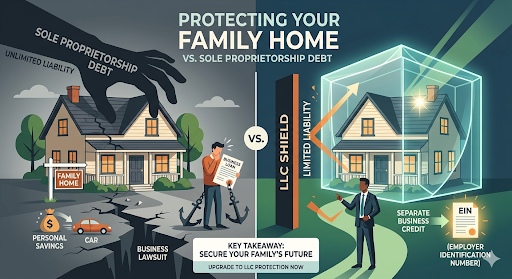
Running a business as a sole proprietor may seem simple and cost-effective, but it comes with a serious legal trade-off: unlimited personal liability. This means your business and personal life are legally the same entity. While this setup works for small, low-risk ventures, it can expose your most valuable personal assets—like your home and savings—to significant risk if things go wrong.
Understanding how liability works and how to protect yourself is essential for long-term financial stability and peace of mind.
Unlimited Personal Liability: What Happens When Your Business is Sued?
When a sole proprietorship faces legal trouble or debt, the owner is personally responsible for everything. There is no legal separation between the individual and the business.
The Absence of a Legal Shield in a Sole Proprietorship
Unlike corporations or LLCs, a sole proprietorship does not create a separate legal identity. This means:
- You are personally liable for all business debts and obligations
- Lawsuits against your business are effectively lawsuits against you
- Creditors can pursue your personal assets to recover losses
There is no ‘corporate veil’ to protect you—because it simply doesn’t exist in this structure. To understand how to build this protection, you should read about the legal differences between an LLC and a sole proprietorship before starting your business.”
Why Your House, Car, and Kids’ Savings are at Risk
If your business is unable to pay its debts or loses a lawsuit, creditors may legally claim:
- Your personal residence (depending on local laws)
- Your car and other valuable property
- Personal bank accounts and savings
- Investments or even funds set aside for your children
Key Risk Factors:
- High-risk industries (construction, consulting, healthcare)
- Signing contracts or loans in your own name
- Lack of insurance coverage
Separation of Personal and Business Credit Profiles
One of the biggest advantages of forming an LLC is the clear separation it creates between personal and business finances.
How an LLC Isolates Business Debt from Personal Credit Scores
An LLC acts as a distinct legal entity, meaning:
- Business debts are tied to the LLC, not you personally
- Your personal credit score is generally protected
- Legal claims are limited to business assets (in most cases)
Benefits of Credit Separation:
- Reduced personal financial exposure
- Easier access to business financing
- Improved credibility with lenders and partners
The Importance of an EIN for Financial Security
An Employer Identification Number (EIN) is like a Social Security number for your business. It plays a crucial role in financial separation.
Why an EIN matters:
- Allows you to open a business bank account
- Helps build a separate business credit profile
- Keeps your personal SSN private in business transactions
- Required for hiring employees and filing certain taxes
Real-World Scenarios of Liability Issues
Understanding real-life examples can highlight the risks of operating without legal protection.
Case Study: Professional Negligence as a Sole Proprietor
A freelance consultant provides advice that leads to financial loss for a client. The client files a lawsuit claiming negligence.
Outcome:
- The court rules against the consultant
- Damages exceed business earnings
- Personal savings and assets are seized to cover the judgment
Lessons Learned:
- Sole proprietors bear full legal responsibility
- Professional liability insurance may not cover all damages
- Personal wealth is directly exposed
Case Study: Defaulting on a Business Lease
A small retail business owner signs a lease under their own name. Due to declining sales, they fail to make payments.
Outcome:
- The landlord sues for unpaid rent
- The owner is personally liable for the full lease amount
- Personal assets are used to repay the debt
Lessons Learned:
- Personal guarantees increase risk
- Long-term contracts can become personal financial burdens
- Lack of legal structure amplifies consequences
Comparison Table: Sole Proprietorship vs. LLC
| Feature | Sole Proprietorship | LLC (Limited Liability Company) |
| Legal Separation | None | Yes |
| Personal Liability | Unlimited | Limited |
| Risk to Personal Assets | High | Low (with proper compliance) |
| Business Credit Profile | Tied to owner | Separate |
| EIN Requirement | Optional | Recommended / Often Required |
| Lawsuit Protection | None | Yes (via legal structure) |
Key Takeaways
- Sole proprietorships offer simplicity but expose personal assets to risk
- There is no legal distinction between owner and business
- An LLC provides a protective legal barrier
- Separating finances is crucial for long-term security
Conclusion
Choosing the right business structure isn’t just a technical decision—it’s a personal one that directly impacts your financial safety and your family’s future. A sole proprietorship may be easy to start, but it leaves your home, savings, and assets vulnerable to business risks. By contrast, forming an LLC creates a legal shield that separates your personal life from your business obligations.
If protecting your family home and financial well-being is a priority, it’s worth considering a structure that offers more than just simplicity—it offers security.
Asset Safety FAQs
Can debt collectors take my personal house for business debts?
Yes—if you operate as a sole proprietor, your personal assets (including your home) can be at risk because there’s no legal separation between you and your business. In some regions, limited protections like homestead exemptions may apply, but they don’t fully eliminate the risk.
Does an LLC protect me from my own professional mistakes?
An LLC generally protects your personal assets from business debts, but it does not shield you from liability for your own negligence or wrongful actions. Professional liability insurance is still essential for full protection.
How fast can BusinessRocket set up my protective LLC shield?
BusinessRocket can typically initiate LLC formation within 1–2 business days, while full approval depends on the state’s processing time. Expedited options may be available to speed up the process further.
