



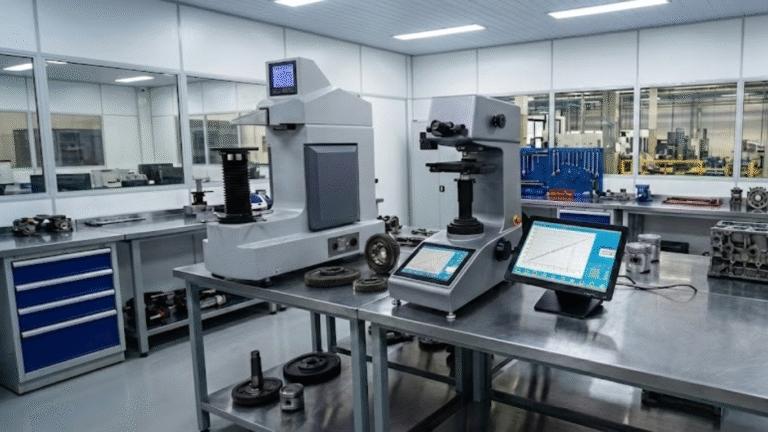
Hardness testing is among the most widely used and diverse materials testing methods in modern manufacturing and research. From the smallest electronic components to massive engine castings, determining a material’s resistance to permanent indentation provides critical data regarding its strength, wear resistance, and heat treatment success.
However, the challenge for many lab managers and quality control teams is that there is no single “perfect” method for every application. Selecting the right Hardness Tester depends on a variety of factors: the required test load, the specific hardness scale, the geometry of the workpiece, and whether the testing needs to happen on a laboratory bench or in the field. Understanding these nuances is the first step toward accurate data. To see how these methods are applied in professional hardware, you can explore various Hardness Tester options from Qualitest.
Why Hardness Method Selection Matters
The field of hardness testing spans an incredible range of force. You might perform micro hardness testing using gram-level loads to evaluate thin coatings, or you might require a heavy-duty Brinell test using up to 3,000 kgf on a large industrial casting.
Choosing the wrong method—such as using a high-load Brinell test on a thin, hardened steel shim—will result in the “anvil effect,” where the material is too thin to support the load, leading to invalid data and a damaged specimen. Conversely, using a micro-load on a coarse-grained cast iron might provide a reading that is not representative of the bulk material. Before choosing a specific model, you must first define the method that fits your material’s characteristics and your workflow requirements.
Rockwell, Brinell, and Vickers: The Core Differences
The three “titans” of hardness testing each utilize a different indenter shape and a different way of calculating the resulting hardness value.
Rockwell Hardness Tester
The Rockwell Hardness Tester is the industry standard for fast, routine production testing. It measures the depth of indentation under a large load compared to the indentation made by a smaller preload.
- Best for: Rapid quality control, heat-treated parts, and metals where speed is a priority.
- Workflow: Because it provides a direct digital or analog readout without the need for optical measurement, the rockwell tester is ideal for high-volume environments.
- Application: Common scales include HRC for hard steels and HRB for softer alloys.
Brinell Tester
The brinell tester uses a heavy load (typically up to 3,000 kgf) and a carbide ball indenter to create a relatively large indentation.
- Best for: Forgings, castings, and materials with a non-homogeneous or coarse grain structure.
- Workflow: The large indentation averages out surface irregularities, making it the most reliable choice for rougher industrial parts.
- Application: Widely used in foundries and for testing heavy-section aluminum or steel alloys.
Vickers Hardness Tester
The Vickers method uses a square-based pyramid diamond indenter. While the technical term is the Vickers Hardness Tester, you may occasionally see it referred to as a Vicker Hardness Tester or vicker tester in certain contexts.
- Best for: Precision lab work, thin sections, and exceptionally hard materials.
- Workflow: It is an optical method, meaning the operator must measure the diagonals of the indentation using a microscope.
- Application: It is the most “universal” of the three because the same indenter can be used for all materials, regardless of hardness.
When a Micro Hardness Tester or Universal Hardness Tester Makes More Sense
Sometimes, the standard “Big Three” methods need to be adapted or combined to suit specific laboratory demands.
Micro Hardness Tester
A micro hardness tester is required when the test loads are very low (typically between 1g and 1kg). This is essential for evaluating:
- Surface-hardened layers (case depth).
- Individual grains within a metal’s microstructure.
- Thin foils, wires, or brittle materials like ceramics and glass.
Universal Hardness Tester
In multi-material labs where samples vary from soft plastics to hardened tool steels, a universal hardness tester is the most efficient choice. These systems are engineered to handle Rockwell, Brinell, and Vickers scales within a single frame. Rather than maintaining three separate machines, a universal system allows the user to switch between methods by changing the indenter and the software settings, providing maximum flexibility for diverse testing demands.
Decision Framework: Which Hardness Testing Method Do You Need?
- Choose Rockwell when… you need high-speed, repeatable results for routine production QC on standard metal parts and want to avoid the time-consuming process of optical measurement.
- Choose Brinell when… you are testing large, rough, or coarse-grained materials like castings and forgings where a small indentation might produce an unrepresentative reading.
- Choose Vickers when… you require the highest level of accuracy for research or when testing very hard or thin materials that require a “scale-less” approach.
- Choose Micro or Universal systems when… your samples are extremely delicate, or your lab handles a constantly changing variety of materials and hardness scales.
The Selection Factors Buyers Should Actually Use
When evaluating hardware, focus on these technical and operational constraints:
- Test Load: Does the machine support the specific gram or kilogram force required by your industry standard (ASTM/ISO)?
- Hardness Scale: Does it cover the specific scales (HRC, HBW, HV, etc.) your customers demand?
- Accuracy: What is the permissible error, and does the system offer digital calibration?
- Workpiece Geometry: Will the part fit in the “throat” of the machine? Do you need specialized anvils for cylindrical parts?
- Portability: Can the parts be brought to the machine, or do you need a portable hardness tester to take to the workpiece?
- Budget: Consider the total cost of ownership, including indenter replacements and annual calibration.
Common Buying Mistakes
- Method Familiarity over Suitability: Don’t buy a rockwell tester just because “that’s what we’ve always used” if you are starting to test thin coatings that actually require a micro hardness tester.
- Ignoring Surface Preparation: Methods like Vickers and Micro-Vickers require a highly polished surface for accurate optical measurement; ensure your lab has the polishing equipment to support the tester.
- Underestimating Part Size: Buying a benchtop unit for a 500lb casting is a logistical nightmare. Consider floorstanding or portable options for heavy parts.
- Neglecting Future Needs: If you are expanding your R&D, a universal hardness tester may be a better long-term investment than three dedicated, single-scale machines.
Portable vs. Bench vs. Floorstanding Hardness Tester Considerations
The physical environment of your test matters as much as the method.
- Portable Hardness Testers: Ideal for large structures, installed pipes, or heavy machinery where taking a sample is impossible.
- Bench Systems: The standard for most labs, providing a stable, controlled environment for routine sample testing.
- Floorstanding Systems: Usually reserved for high-capacity brinell tester applications or massive parts that require a reinforced frame and a larger testing table.
Why Buyers Compare Hardness Testers on Qualitest
Qualitest provides one of the most comprehensive hardness testing portfolios on the market, spanning portable units, dedicated Rockwell and Vickers systems, and advanced universal platforms. Because their lineup is built around the core selection factors—load, scale, accuracy, and workpiece shape—it serves as a practical reference for engineers who need to bridge the gap between theoretical material science and practical quality assurance.
Explore Hardness Tester options from Qualitest and request a quote for the Rockwell, Brinell, Vickers, micro, or universal system that fits your application.
Final Thought
The “best” hardness testing method is ultimately defined by the material you are testing and the environment in which you are testing it. By selecting the correct method—whether it be the speed of Rockwell, the bulk averaging of Brinell, or the precision of Vickers—you ensure that your data is both accurate and compliant with global standards. Always define your load requirements and workpiece geometry first, then choose the Hardness Tester configuration that aligns with your lab’s long-term throughput and accuracy goals.
