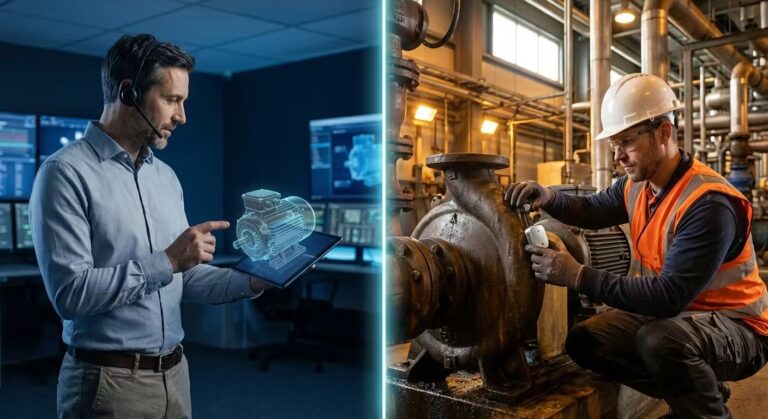
Industrial operations across the United States are under consistent pressure to reduce unplanned downtime, control maintenance costs, and maintain output quality without adding significant labor overhead. Plant managers, operations directors, and maintenance engineers are increasingly being asked to do more with the same resources — and in many cases, with fewer experienced technicians on the floor.
The decision to invest in equipment monitoring technology is rarely taken lightly. Capital budgets are constrained, integration requirements are complex, and the consequences of choosing the wrong system can set an operation back by months. This guide is written for industrial decision-makers who are evaluating their options seriously and need a clear, grounded breakdown of what actually matters when selecting a monitoring platform — before a purchase order is signed.
Understanding What a Machine Monitoring System Actually Does in Practice
A machine monitoring system collects real-time data from industrial equipment — motors, compressors, conveyors, CNC machines, HVAC units, and other critical assets — and translates that data into actionable insight about equipment health, performance trends, and potential failure conditions. The core purpose is not to generate reports. It is to give operations teams a reliable, continuous picture of what is happening inside their equipment before problems become visible to the naked eye or audible to the human ear.
For companies evaluating platforms, a well-designed machine monitoring system should integrate with existing equipment without requiring a full infrastructure overhaul, and it should surface meaningful data at the right level of detail for the people who need to act on it. The distinction between systems that collect data and systems that actually reduce downtime often comes down to how that data is structured, delivered, and acted upon across departments.
The Gap Between Data Collection and Operational Value
Many industrial companies have invested in sensors or basic telemetry tools only to find that the data sits unused in dashboards that no one checks. This is not a technology failure — it is a design failure. A monitoring platform that generates overwhelming volumes of raw data without filtering for relevance creates alert fatigue among maintenance teams, which is arguably worse than having no system at all. When every reading triggers a notification, technicians begin ignoring the alerts, and the system loses its operational value entirely.
The better systems are designed with the end user in mind: the maintenance technician who needs to know which machine to look at first, the plant manager who needs a weekly summary of asset health, and the reliability engineer who needs trend data over a rolling period to make informed decisions about equipment replacement cycles.
Real-Time Condition Monitoring Without Latency
Condition monitoring is the foundation of any credible monitoring platform. It refers to the continuous measurement of physical parameters — vibration, temperature, current draw, pressure, and acoustic signatures — to detect deviations from normal operating baselines. When a bearing begins to degrade or a motor starts drawing more current than expected, condition monitoring data captures that shift before it becomes a failure event.
Why Latency Is a Non-Negotiable Factor
In a high-speed production environment, a delay between a sensor reading and an operator alert can mean the difference between a maintenance intervention and a catastrophic equipment failure. Systems that batch data and upload it on a scheduled interval — rather than streaming it in near real-time — are fundamentally unsuited for environments where equipment runs continuously. Any platform under serious evaluation should be able to demonstrate its data transmission speed under realistic operating conditions, not just under controlled test scenarios.
Compatibility With Existing Equipment and Control Architecture
Most US industrial facilities are not greenfield operations. They have legacy equipment, existing SCADA systems, PLCs from multiple manufacturers, and a mix of wired and wireless infrastructure. A monitoring solution that only works cleanly with new equipment or specific brands is a significant limitation for the majority of buyers in this market.
Protocol Support and Integration Depth
Industrial communication protocols such as Modbus, OPC-UA, PROFINET, and EtherNet/IP are common in manufacturing and process environments. A monitoring system that supports a broad range of these protocols without requiring custom middleware for every integration reduces deployment time and total cost of ownership. Before any vendor conversation goes too far, a compatibility audit of the plant’s existing control architecture should be completed. Systems that cannot speak the same language as your existing infrastructure will require costly custom integration work that rarely delivers clean results.
Scalable Architecture for Multi-Site or Growing Operations
A monitoring system that works well for one facility should also be capable of expanding to cover additional facilities without requiring a parallel implementation from scratch. Companies with multiple plants or those planning to grow need to think beyond their immediate deployment requirements and evaluate whether the platform they choose can scale without becoming an administrative burden.
Centralized Visibility Across Distributed Assets
Multi-site manufacturers need a single pane of glass — a centralized view that shows the health of assets across all locations without requiring separate logins or platform instances for each site. Systems that are architecturally siloed make it difficult to compare performance across plants, identify systemic issues, or prioritize capital allocation based on which assets carry the most operational risk across the organization.
Predictive Maintenance Capabilities Grounded in Pattern Recognition
Predictive maintenance moves beyond scheduled service intervals and reactive repairs. It uses historical performance data and real-time readings to identify patterns that precede specific failure modes, giving maintenance teams enough lead time to schedule repairs during planned downtime windows rather than responding to unexpected breakdowns.
The Difference Between Alerts and Predictions
An alert tells you something has already changed. A prediction tells you what is likely to happen if the current trend continues. Systems that rely solely on threshold-based alerts — where a notification fires only when a reading exceeds a set limit — are inherently reactive. True predictive capability requires baseline modeling, trend analysis over time, and some degree of statistical reasoning about failure probability. This is a meaningful technical distinction that buyers should press vendors to explain clearly during evaluation.
Role-Based Access and Dashboard Customization
Different people within an industrial organization need different views of the same data. A maintenance technician needs asset-level detail and fault codes. A plant manager needs a summary view of asset health and maintenance activity. An executive needs aggregated reliability metrics across the business. A system that provides only one dashboard type forces users to filter through irrelevant information or, more commonly, stops being used altogether.
Data Security and Compliance With Industrial Cybersecurity Standards
As more industrial systems connect to cloud infrastructure or enterprise networks, cybersecurity becomes a legitimate operational concern. The Cybersecurity and Infrastructure Security Agency has published extensive guidance on protecting industrial control systems from network-based threats, and any monitoring platform that connects to cloud services should be evaluated against these frameworks. Data encryption in transit and at rest, access control policies, and audit logging are baseline requirements, not optional features.
Edge Computing Capability for Environments With Limited Connectivity
Not every industrial facility has reliable broadband connectivity at every point on the plant floor. Warehouses, outdoor processing areas, and remote sites often have limited or intermittent network access. A monitoring system that requires continuous cloud connectivity to function will fail or produce gaps in data in these environments. Edge computing capability — where data is processed and stored locally before being synchronized to a central system — ensures continuity even when network conditions are unreliable.
Maintenance Workflow Integration With CMMS Platforms
A machine monitoring system that operates in isolation from a facility’s computerized maintenance management system creates a disconnect between detection and action. When an alert fires, a work order needs to be generated, assigned, tracked, and closed. If that process requires a technician to manually bridge two separate systems, steps will be missed and accountability will be inconsistent. Direct integration with common CMMS platforms closes this gap and gives maintenance managers a complete record of asset history tied to real sensor data.
Vendor Support Infrastructure and Implementation Resources
The quality of a vendor’s post-sale support structure has a direct impact on how quickly a monitoring deployment reaches full operational value. Systems that are technically capable but poorly supported during commissioning often take significantly longer to produce results. Buyers should ask vendors specific questions about implementation timelines, on-site support availability, training programs for maintenance staff, and escalation procedures when technical issues arise.
Total Cost of Ownership Beyond the Initial License Fee
The purchase price of a monitoring platform represents only a portion of the true cost of ownership. Hardware, installation, connectivity infrastructure, staff training, system administration, and ongoing software subscription fees all contribute to the total investment. Companies that evaluate platforms purely on initial cost often find themselves facing unexpected expenses during deployment or annual renewal that were not factored into the original budget. A detailed total cost of ownership analysis should be a standard part of any evaluation process.
Reporting and Analytics That Support Long-Term Asset Planning
Beyond day-to-day maintenance decisions, a monitoring platform should generate historical trend data that informs longer-term capital planning. Knowing which assets are degrading faster than expected, which maintenance strategies have extended equipment life, and where the highest failure frequency is concentrated across a facility gives operations leaders the evidence base they need to make defensible decisions about equipment replacement, process redesign, or capacity investment.
Connecting Monitoring Data to Operational Outcomes
The most valuable reporting is not the kind that shows raw sensor readings over time. It is the kind that connects equipment behavior to operational outcomes — production throughput, quality metrics, energy consumption, and maintenance labor hours. When monitoring data is mapped to these outcomes, it becomes a management tool rather than a technical log, and it earns a place in budget conversations rather than being confined to the maintenance department.
Making a Decision That Holds Up Over Time
Evaluating a machine monitoring system is not a short process, and it should not be rushed. The features outlined in this guide represent the operational realities that distinguish systems that deliver sustained value from those that create new administrative burdens without meaningfully improving reliability.
The right platform will align with your existing infrastructure, scale with your operational footprint, support the people who use it daily, and provide the kind of forward-looking data that allows your maintenance and operations teams to act with confidence rather than react under pressure. Vendors who resist detailed technical questions, downplay integration complexity, or focus conversations on feature counts rather than operational outcomes are worth approaching with caution.
A thorough evaluation process — one that includes live demonstrations in conditions that reflect your actual environment, references from comparable industrial users, and a clear contractual understanding of support obligations — is the most reliable way to make a decision that holds up over the full operational life of the deployment.
Trending
- Buying a Yacht in Dubai: What to Consider Before Making an Offer
- How a Clearer Photo Helps a Video Only When the Detail Was Already There
- Everything UK Pilgrims Ask About Umrah Visas and Packages
- The Best Home Crypto Miners of 2026, and Which Coins Are Actually Worth Mining
- How to Choose a Fluid Extractor Pump for Automotive Use
- The Death of the Product Photo: Why Brands Are Moving to Animated 3D Content
- Machine Monitoring System Buyer’s Guide for US Industrial Companies: 12 Features You Cannot Compromise On
- Top Food Processing Equipment Manufacturers and Distributors in Canada

Machine Monitoring System Buyer’s Guide for US Industrial Companies: 12 Features You Cannot Compromise On