



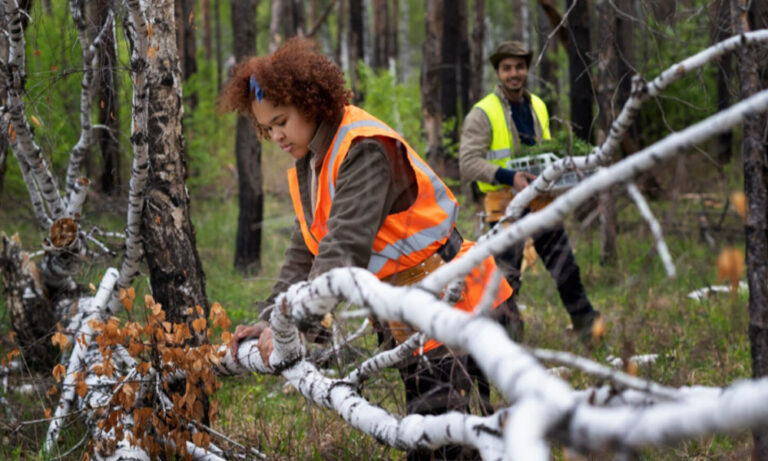
Tree work can move a team from a roadside garden to a woodland slope in the same week. The distance from the vehicle, the terrain and the availability of a phone signal can change as much as the task itself. First-aid preparation needs to reflect that movement.
A kit selected for arboricultural work should fit into an emergency plan that the whole crew understands. Supplies, training, communication and access all need attention. Preparing them together helps the team avoid discovering, during an incident, that an essential item or piece of information is somewhere else.
Begin with the actual job and location
Review the day’s work before unloading equipment. Consider the planned cutting and climbing activities, the size and distribution of the crew, and how someone would reach each work position. A familiar type of job can still present unfamiliar access problems at a new site.
The HSE’s tree-work first-aid guidance recommends a personal kit containing haemostatic dressings, a tourniquet, gloves and a resuscitation aid, with suitable training in their use, alongside a central worksite kit. It also highlights emergency planning and access to casualties. These points should inform a competent assessment of the team’s provision.
When comparing a tree surgeon first aid kit, Mere Supplies’ forestry and arboriculture range offers a relevant product category to explore. Check the actual contents, dimensions and carrying arrangements against the assessment. A trade-specific name on the bag is a useful search aid, but it does not confirm suitability for every crew or job.
Give personal and worksite kits distinct roles
A personal kit and a central kit solve different access problems. The personal kit is intended to remain with the worker; the central kit supports the wider worksite arrangements. Decide how both will be carried and checked before choosing where additional supplies belong.
For a climbing worker, discuss attachment and accessibility with the competent person responsible for the climbing system. A pouch should fit the planned work without obstructing movement or creating an avoidable snagging problem. Test the arrangement during supervised preparation, using training equipment where opening clinical supplies would compromise them.
Ground workers need accessible provision too. A kit left in a locked vehicle may be convenient for storage but poorly placed for an active work area some distance away. Agree when the worksite kit should move as the job progresses and who is responsible for moving it.
Keep personal kits recognisable to colleagues. Consistent placement and clear identification make it easier for a team member to locate supplies without searching through unrelated tools. Ask each worker to demonstrate where their kit is during the briefing rather than relying on an assumption.
Make training specific to the equipment
Specialist items need appropriate training and practice. The purchasing decision should include a discussion with a competent training provider about the selected equipment and the scenarios relevant to the work. A list of contents is not an instruction for treatment.
Use separate practice supplies for exercises. Repeatedly opening or handling operational items can leave the working kit incomplete or affect packaging integrity. Label training equipment clearly and store it separately so that it is not mistaken for ready-to-use clinical stock.
Review competence when equipment changes. A replacement product may differ in packaging or operation even when it serves a similar purpose. Give the crew a chance to become familiar with it before the next job, and refer questions about use to an appropriate instructor.
Treat access and rescue as part of preparation
A person may need help in a tree, beyond a steep bank or near heavy timber. First-aid supplies cannot by themselves resolve those access problems. The job’s rescue arrangements should identify suitable people, equipment and procedures for the foreseeable situations.
Discuss how the rest of the work will be made safe while help is provided. Noise, moving equipment and other ongoing activity can complicate communication. Allocate roles in advance so that the response does not depend on several people independently deciding to do the same thing.
For an unfamiliar site, walk the route from the work area to the agreed emergency access point. Check gates, surface conditions and obstacles. If the weather changes that route, revisit the arrangement. A plan based on yesterday’s dry track may need revision after sustained rain.
Prepare location information that can be passed on
Write a brief site emergency card and keep it accessible to the crew. Make the information usable by someone who is stressed or unfamiliar with the area. It should identify the work location and the agreed way to guide help from the nearest suitable road access.
Useful briefing points include:
- The worksite location, with an appropriate grid reference or coordinates.
- The correct entrance and any gate or access arrangements.
- The tested method for raising an alarm from the work area.
- The person assigned to meet and guide arriving responders.
- The location of personal, worksite and rescue equipment.
- The alternative arrangement if the main communication method fails.
Test the plan as a crew. A location saved only on one person’s phone may become unavailable at the moment it is needed. Provide an appropriate backup, and ensure more than one person can explain the route and the communication process.
Protect supplies from the working environment
Inspect the carrying system as well as the medical contents. Mud, rain, abrasion and routine handling can affect a bag’s closures and internal organisation. Check that supplies remain protected and that the kit can be opened as intended.
Make replenishment straightforward. Keep a contents record, identify the person responsible and arrange a replacement source before supplies are needed. After any use, record what has been removed and restore the agreed provision before the kit returns to service.
Pay attention when vehicles and crews change. A bag can remain in the previous vehicle while everyone assumes it moved with the team. Include kit presence and condition in the departure check, then confirm the worksite location during the arrival briefing.
Use short exercises to improve the plan
A brief rehearsal can expose details that a written assessment misses. Ask one person to describe the location, another to find the equipment and another to explain the access arrangements. Review delays or uncertainty without turning the exercise into a test of confidence.
Update the plan when the job, crew or conditions change. A practical first-aid system for tree work is built from appropriate supplies, competent use and dependable arrangements around them. Keeping those elements connected makes preparation relevant to the place where the team is actually working.
