



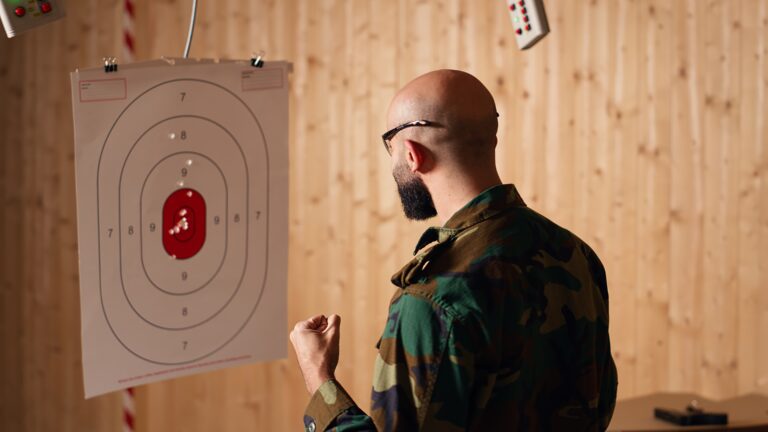
Most shooters approach target selection as an afterthought. The assumption is that a target is a target — something you put downrange, shoot at, and replace when it wears out. But for anyone who trains regularly, whether at a private range, a club facility, or on personal land, that assumption leads to repeated purchases, frustrating performance, and equipment that fails to hold up under real training conditions.
The market for reactive and self-healing targets has grown considerably, and with that growth has come a wider spread in quality, material composition, and appropriate use cases. Buyers who do not understand what separates a well-designed target from a marginal one tend to make the same errors. They buy on price, misread product descriptions, choose the wrong format for their caliber or discipline, or ignore factors that only become apparent after several hundred rounds.
This article addresses ten of the most common purchasing mistakes — not as a shopping guide, but as an honest look at where buyers tend to go wrong and why those mistakes carry real operational consequences.
1. Treating All Self-Healing Materials as Functionally Equivalent
When a buyer encounters the term self-healing shooting target, the assumption is often that the defining feature — the material’s ability to close around a bullet path — works the same way across all products. It does not. The formulation of the compound, its density, the additives used, and the manufacturing process all affect how the material responds at different calibers, velocities, and round counts. A self-healing shooting target designed for handgun rounds will behave very differently under rifle fire, and treating those two categories as interchangeable is one of the most common sources of premature target failure.
Why Material Composition Shapes Longevity
The core property that allows these targets to function is the internal structure of the compound itself. When a projectile passes through, the material compresses and then attempts to return toward its original shape. Higher-density formulations handle this cycle more effectively at elevated velocities, while softer compounds may work adequately for lower-powered cartridges but degrade quickly under repeated high-velocity impacts. Buyers who do not verify the material’s rated caliber range often discover this problem only after the target is already compromised.
2. Buying Based on Price Alone
Price is a legitimate consideration, but it is not a reliable indicator of suitability in this category. The lowest-priced options in the self-healing target segment frequently use lower-grade compounds that wear at a significantly faster rate. When you factor in replacement frequency, the cost per round of engagement is often higher with a budget option than with a mid-range product that holds up over several thousand rounds.
The Hidden Cost of Short Lifespan
A target that requires replacement after minimal use does not save money. It also introduces interruption into training schedules, which matters more for structured programs than casual use. Facilities that run regular drills or instructional sessions need equipment that remains consistent across sessions. A target that changes shape, loses density, or begins to fragment partway through a training block creates inconsistency in the feedback shooters receive, which undermines the purpose of the session.
3. Ignoring the Caliber and Velocity Rating
Every self-healing target has a practical threshold — a range of calibers and velocities at which it performs as intended. Manufacturers establish these ratings based on internal testing, and exceeding them does not simply reduce lifespan. It can cause the material to tear, crack, or shed fragments rather than absorb the impact cleanly. Shooters who regularly use rifle calibers and purchase targets rated only for pistol use will see rapid degradation and, in some cases, potential downrange hazard from material behavior.
Understanding the Relationship Between Velocity and Material Stress
The energy transferred by a projectile is not just a function of caliber — it is a combination of mass, velocity, and construction. A fast, lightweight rifle round may impose more stress on target material than a slower, heavier handgun round at certain energy thresholds. According to basic principles covered in the physics of ballistics, the impulse delivered to the target material determines how thoroughly the self-healing mechanism is stressed with each impact. Buyers who do not account for this often attribute early failure to a defective product when the actual cause is a use-case mismatch.
4. Selecting the Wrong Target Format for the Intended Discipline
Self-healing targets come in multiple formats — cube-style blocks, bag targets, layered systems, and profile-shaped designs. Each has strengths suited to particular training applications. A block target optimized for archery or crossbow may not present the right surface geometry or density for handgun drills at close range. A layered bag design may excel at absorbing broadheads but wear inconsistently under repeated pistol fire concentrated on a small zone.
Format and Drill Type Must Align
Drills that concentrate fire on a single point — like repeated draw-and-fire repetitions at a defined zone — will stress a target differently than patterns that distribute impacts across a broader area. Buyers planning structured repetition drills need a format that can handle localized wear. Choosing a format designed for dispersed impact patterns and then running tight, repetitive drills on it is a common mismatch that accelerates failure in specific zones while the rest of the target remains intact.
5. Overlooking Environmental Storage Requirements
The compound used in self-healing targets is sensitive to temperature and UV exposure. Extended storage in extreme heat causes some formulations to soften permanently, altering their density and reducing their ability to close around impact channels. Cold temperatures can make the material brittle, which increases the chance of cracking on the first impacts after retrieval. Buyers who store targets in outdoor sheds, vehicle trunks, or uninsulated spaces without accounting for seasonal temperature swings often find that targets arrive at the range already compromised.
Storage Conditions Are Part of the Product’s Service Life
Manufacturers design their targets for use within certain environmental parameters, but buyers rarely read the storage guidance. This is not a minor technical footnote. A target that has been heat-softened or cold-hardened will not perform the same as one stored correctly, and the difference in round count before noticeable wear can be substantial. Treating the storage environment as irrelevant effectively shortens the product’s usable life before a single shot is fired.
6. Assuming All Brands Use Consistent Quality Control
The manufacturing process for self-healing target compounds is not uniformly regulated across the industry. Some producers maintain tight controls over density, compound ratios, and curing times. Others allow wider variance. A buyer who has had a positive experience with one batch of a given product and then orders a subsequent batch may notice meaningful differences in performance if the manufacturer’s quality consistency is poor. This inconsistency is rarely disclosed upfront and is only discovered through use.
7. Not Accounting for Round Count Per Session
Buyers often evaluate a target by its stated lifespan in total round count, but they do not factor in how many rounds are fired per session or how concentrated those impacts are. A target rated for a high total round count under dispersed, casual-use conditions may show visible wear within a single intensive session if fire is concentrated on a small impact zone at high repetition. The total round count figure is an average under distributed use, not a guarantee under concentrated fire.
Session Intensity Affects Actual Lifespan
Training environments that involve rapid fire, multiple shooters, or focused point drills will consume a target’s useful life faster than the stated round count implies. Understanding this distinction allows buyers to select targets that are appropriately specified for the way they actually train, rather than being misled by headline figures that do not reflect their use pattern.
8. Choosing a Target Without Considering Mounting and Setup Compatibility
Some self-healing targets require specific stands, frames, or hanging systems that are not included with the product. Buyers who purchase a target without verifying that compatible mounting infrastructure is available at their range may find themselves improvising solutions that create safety concerns or result in inconsistent target positioning. A target that moves unpredictably during a drill introduces variables that undermine the training value and can present handling risks depending on the setup.
9. Disregarding Audible and Tactile Feedback Characteristics
One of the practical benefits of self-healing targets is the feedback they provide — a visible reaction on hit and, in many cases, an audible response that confirms impact without requiring the shooter to stop and inspect. Buyers who do not evaluate this characteristic before purchasing may end up with a target that provides inadequate feedback for their specific training method, particularly when shooting at distance or in low-light conditions. The feedback properties vary between designs and materials, and they are worth evaluating as part of the selection process, not after the purchase.
10. Failing to Rotate Impact Zones
This is a user behavior mistake rather than a purchasing mistake, but it is worth addressing here because it directly affects how long a target lasts after purchase. Shooters who repeatedly hit the same small zone do not distribute wear across the target’s available surface. The material in the impact zone compresses repeatedly before it has time to recover, which accelerates degradation in that area. Rotating fire across the full target face, when the drill permits, significantly extends the usable life of any self-healing design.
Why Recovery Time Matters Between Sessions
The self-healing mechanism is not instantaneous in all materials. Some compounds require hours or days to fully return toward their pre-impact structure, particularly after sustained use. Allowing a target adequate recovery time between heavy sessions extends the total round count and maintains consistency. Buyers who train daily on the same target without rotation or recovery periods will see performance decline faster than the product rating suggests. According to materials science principles, repeated cyclical compression without adequate recovery time leads to progressive material fatigue, a phenomenon well-documented in viscoelastic materials, which share key properties with the polymers used in these targets.
Conclusion: Better Decisions Start With a Clear Understanding of the Product
The mistakes outlined here share a common root: treating self-healing targets as a simple commodity purchase rather than a piece of training equipment with real performance characteristics. Each mistake carries a cost — financial, operational, or both. Replacing targets prematurely interrupts training schedules, adds expense that compounds over time, and can produce inconsistent results that affect the quality of practice.
Avoiding these errors does not require specialized expertise. It requires asking the right questions before purchase: What calibers and velocities will this target handle? What format suits the intended drills? What environmental conditions will it be stored in, and how intensively will it be used per session? These are not complex questions, but they are the ones most buyers skip.
Buying well the first time is almost always more cost-effective than correcting a mismatch after the fact. The time spent understanding what a target is actually designed to do will return that investment many times over across the life of the equipment.
