



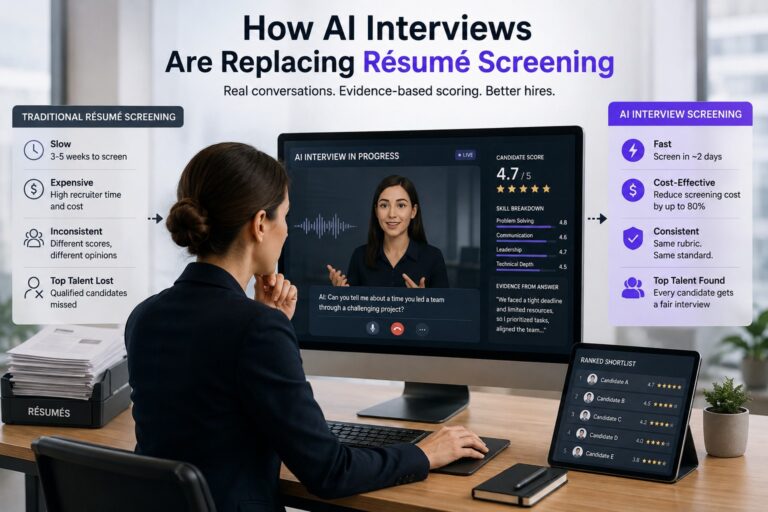
Every recruiting team has faced the same math problem. A single open role attracts hundreds of applicants, but only a handful will ever get a real conversation with a hiring manager. The rest are filtered out by a résumé scan, a keyword match, or a recruiter working through a stack of applications at 11pm. Somewhere in that process, qualified candidates are lost, not because they lacked the skills, but because no one had time to find out.
This is the gap that AI-led interviewing is built to close. Instead of filtering applicants on résumé keywords alone, a growing number of talent teams are now running a real interview with every applicant, automatically, and using the transcript itself as the basis for scoring and shortlisting.
The Real Cost of Manual Screening
Traditional screening looks efficient on paper. In practice, it carries three hidden costs that compound as a company scales:
It is slow. Sourcing, résumé review, phone screens, and scheduling can stretch a first round of hiring across three to five weeks. In competitive markets, strong candidates accept another offer before your team gets to them.
It is expensive. Recruiter time is not free. Reviewing résumés, coordinating calendars, and running phone screens for a few hundred applicants can easily run into tens of thousands of dollars in labor cost for a single role, most of which goes toward candidates who are never seriously considered.
It is inconsistent. The same answer, given to three different interviewers, often receives three different scores. Without a shared rubric, hiring decisions lean on gut feel, which is difficult to defend and easy to bias.
What a Structured AI Interview Looks Like
An AI interview platform such as AI Interviews addresses each of these problems by changing where screening happens in the funnel. Rather than narrowing applicants down before anyone talks to them, every candidate is invited to a live, voice-based interview conducted by an AI agent trained on the specific job description.
A few characteristics separate this approach from a traditional application form or a recorded one-way video screen.
A Real, Adaptive Conversation
The interview is spoken, not typed, and the AI agent asks genuine follow-up questions based on what the candidate just said. If a candidate claims they resolved a missed deadline, the agent will ask how, what trade-offs were made, and what the outcome was. This produces a transcript that reflects actual reasoning rather than rehearsed, generic answers.
Scoring Backed by Evidence
Each candidate receives a score built from the transcript itself, not a black-box number. A hiring manager can see the specific quote that produced a given score for stakeholder management, delivery, or technical depth. This turns “gut feel” into a documented, defensible rationale, and it applies the same rubric to every candidate, closing the consistency gap that plagues human-led screening.
Fraud and Integrity Checks, Built In
As AI tools make it easier for candidates to have answers written or coached in real time, screening integrity has become a genuine operational risk. A structured AI interview platform can verify candidate identity, detect a second voice in the room, flag pasted or AI-generated phrasing, and monitor for a candidate reading off-screen, all during the live interview rather than after the fact.
Native ATS Integration
For enterprise teams, screening cannot exist as a separate workflow bolted onto the hiring process. Platforms built for scale connect directly with the applicant tracking systems teams already use, including Greenhouse, Lever, Workday, Ashby, SAP SuccessFactors, and BambooHR, so applicants flow in and scored, ranked shortlists flow back automatically.
The Business Case for AI-Led Screening
For talent acquisition leaders evaluating this shift, the appeal is not the novelty of AI. It is the measurable change to four numbers recruiting teams already track:
- Speed. A first-round screening process that previously took three weeks can be compressed to roughly two days, since every candidate is interviewed on their own schedule rather than waiting for a recruiter’s calendar to open up.
- Cost. Per-candidate screening cost drops sharply when the interview is run by software rather than by a recruiter’s billable hours, often to a fraction of what a single phone screen costs today.
- Integrity. Live proctoring and evidence-backed transcripts catch coached or fabricated answers before they reach a hiring manager, protecting the integrity of the shortlist.
- Quality of hire. Because candidates are evaluated on what they actually said in response to real follow-up questions, rather than on résumé keywords, teams report a meaningfully stronger correlation between screening scores and on-the-job performance.
Where This Fits in the Hiring Process
AI-led interviewing is not intended to replace the final conversations a hiring team has with a candidate. It replaces the earliest, highest-volume stage of screening, the part of the funnel where hundreds of applicants are reduced to a manageable shortlist. By the time a hiring manager gets involved, they are reviewing a small number of candidates who have already been interviewed, scored on evidence, and checked for integrity, rather than skimming résumés and hoping the right person is in the pile.
For companies hiring at volume, whether in technology, healthcare, financial services, or retail, this shift changes the fundamental economics of screening. Every applicant gets a fair, structured interview instead of a small fraction getting attention. The result is a shortlist built on evidence rather than on who happened to have the right keywords or who a recruiter had time to call back.
Getting Started
Platforms built for this shift are designed to plug into an existing hiring workflow with minimal setup. Teams typically paste in a job description, let the AI draft a structured interview and skill weighting in minutes, and send a single link to candidates. From there, interviews run asynchronously, and a ranked, evidence-backed shortlist is ready within a couple of days.
For talent teams weighing where AI genuinely improves hiring outcomes rather than just adding another tool to the stack, structured AI interviewing is one of the clearer cases. It does not just make screening faster. It makes screening fairer, more defensible, and available to every applicant, not just the ones who make it past the first filter.
Teams that want to see it against their own job description can start a free trial with 30 interviews included, with no credit card required.
