



A coding request to Claude Opus 5 produced one sentence, then stopped at a tool call. The route had injected roughly 19,700 tokens of agent tooling, and the model was waiting for tool results that an ordinary, non-agent caller could not provide. That looks a lot like “empty content” from the developer’s side—even though it is really an integration dead end.
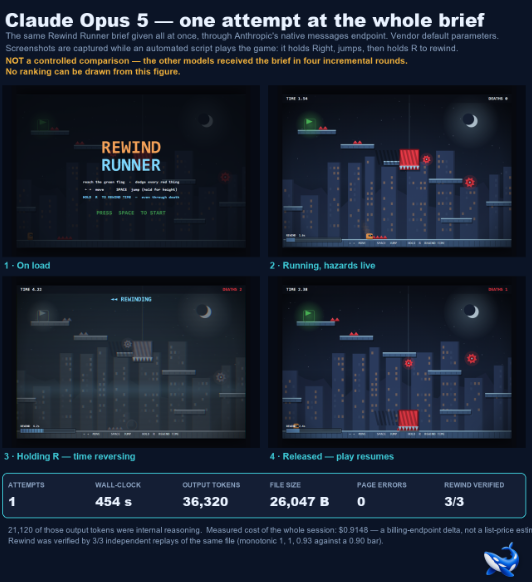
The useful twist came from changing the route, not changing the model. Using the same model, gateway, and key through Anthropic’s native messages endpoint returned normal thinking and text blocks, then a complete 26 KB game whose rewind mechanic was verified 3/3.
Disclosure: I work with OrcaRouter and used it to run this evaluation. One OpenAI-compatible key gave me access to every model in this test, without changing how any model answered.
AI-generated illustration featuring official model logos; logos and model names are used descriptively and remain the property of their respective owners.
Explore Claude models on OrcaRouter.
The practical fix: change the endpoint before blaming the model
For this task, the native route received the entire brief at once and used a time-boxed feedback loop. That is not proof that every native request will outperform every OpenAI-compatible request. It is a narrow observation that a route can shape whether a coding response is usable at all.
If a Claude coding request ends in tool_calls with no usable text, first check whether your client can actually execute and return those calls. If it cannot, try Anthropic’s native messages endpoint before concluding that the model cannot do the work. The observed difference here is about API integration, not consumer-product behavior or a general measure of model quality.
There was a second, less glamorous failure mode: output budget. The first native launch hit a 32K ceiling because that ceiling includes hidden reasoning as well as the answer. Raising it to 64K allowed the task to finish. In this case, calling the truncated first attempt a model failure would have been misleading; it was a configuration fault.
What this test did—and did not—show
The Rewind Runner check was behavioral: a headless browser sent fixed keys, fingerprinted changing pixels, and tested whether matched pre-rewind frames moved backward. A pass required three replays to clear the monotonic-score threshold. It checks the rewind mechanic, not whether the game is enjoyable.
Most importantly, this is n=1 per run or attempt: a case study, not a benchmark. Claude Opus 5 was tested separately through its native endpoint and must not be ranked against the controlled GPT-5.6 Terra and Kimi K3 exercise. That other exercise used one run per model per round, four ordered prompts, vendor-default parameters, and no human quality rubric. Vendor effort labels should not be read as equal compute, either.
There was also a human play report, but it was one named, non-blinded player for a few minutes, with no rubric. Treat that as a small anecdote about play, not proof that a level is good, bad, or impossible.
Developer takeaway
When a Claude request appears to return nothing, inspect the response structure before retrying prompts at random:
- Check whether the response is waiting on tool results your caller cannot supply.
- Try the vendor-native endpoint as an integration diagnostic.
- Increase the token ceiling when the task needs both substantial reasoning and a substantial deliverable.
- Verify the artifact with a task-specific check rather than treating successful text generation as success.
The lesson is pleasantly unheroic: sometimes the model did not fail the task. The plumbing failed the model.
First-party Rewind Runner test record. It documents this case study’s observed result, not a universal model ranking.
Limitations
This report covers one case-study attempt per run, not stable behavior across workloads. It does not compare Claude Opus 5 with Terra or Kimi, does not establish consumer-product behavior, and does not use a blinded human quality evaluation.
Sources
First-party Rewind Runner records: native-route API observations, token-ceiling observation, and Rewind Runner behavioral test record.
This evaluation was run through OrcaRouter. The author works with OrcaRouter; model access does not imply affiliation with, endorsement by, or sponsorship from model providers. Model names and logos are used descriptively. All trademarks belong to their respective owners.
