



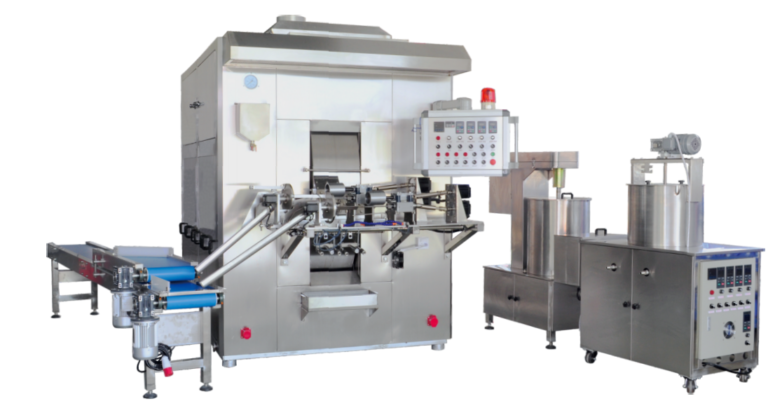
Peak season puts a different kind of pressure on wafer roll manufacturers. Sales teams see a demand window, finance sees a chance to use fixed costs more efficiently, and production managers see a narrower margin for maintenance mistakes. At first, a faster line may look like the obvious answer, but the more useful question is whether the factory can keep that line clean, guarded, staffed, and supplied when the order book is full. Because of that, a maintenance-led review often gives better buying discipline than a speed-first comparison.
Published UDTECH automatic egg roll machine specifications give a practical place to start because they list model output, footprint, power, fuel demand, installation time, training time, and support coverage. Baseline planning starts with the UD05-2, listed at 220 pieces per minute and about 600 kg per 8-hour shift, while the UD05-3 is listed at 330 pieces per minute and about 900 kg per shift. Those figures are valuable, but they become operational only when maintenance can translate them into cleaning windows, inspection points, operator routines, and parts planning.
Maintenance questions behind peak-season capacity
Many snack plants first compare automatic equipment by output per minute. That number matters, but it is incomplete. During a peak program, one unexpected stoppage can erase the advantage of a higher rated speed. Even a belt alignment issue, a blocked filling system, an oven temperature drift, or a missing sanitation tool can turn a planned shift into a recovery exercise. During selection, the purchase team should ask how the equipment will behave on the third week of a peak run, not only during the acceptance demonstration.
Start the practical review with the failure points in the current process. When manual rolling creates most of the rework, integrated roll forming may be the most valuable upgrade. Where filling variation is the bottleneck, automatic core injection deserves special attention. When operators spend too much time correcting thin wrappers or overheated sheets, wrapper thickness control and temperature control become more important than maximum headline output. Machine choice should answer a real maintenance and production pattern, not a generic wish for automation.
From there, the same review should list which stoppages are expensive because they interrupt flow and which stoppages are expensive because they require skilled diagnosis. For example, a forming adjustment that takes six minutes but happens four times a shift belongs in a different category from a burner or drive issue that stops the line for an hour. Maintenance teams can use that distinction to decide which checks belong in an operator routine, which belong in a weekly preventive task, and which require supplier support. Such a file explains that explains how the new wafer roll line will be protected during the busiest weeks, not just how it performed during a clean demonstration.
Building a shutdown scorecard before the line is busy
A useful scorecard separates planned downtime from surprise downtime. Planned downtime includes daily cleaning, weekly inspection, lubrication, burner checks, staff handover, and batter system review. Surprise downtime includes jam recovery, unstable forming, uneven heating, gas supply interruption, and avoidable operator error. Buyers should estimate each item before signing the order because the figures shape both staffing and payback.
Peak-season maintenance scorecard for a wafer roll line
| Review point | What to confirm before purchase | Why it affects capacity |
| Daily cleaning path | Access around forming, filling, oven, and contact areas | Long cleaning routines reduce usable shift hours |
| Heat stability | Expected temperature tolerance, warm-up behavior, and fuel supply stability | Temperature drift creates color variation and scrap |
| Filling repeatability | Core injection settings, adjustment method, and cleaning access | Inconsistent filling slows packing and increases rejects |
| Operator handover | Training plan, set point records, and shift-start checklist | Good handover prevents repeated start-up losses |
Why cleanability and guarding cannot be late-stage items
Food equipment decisions should include sanitation and maintenance access from the first review. U.S. food equipment rules under 21 CFR 117.40 focus on maintaining equipment so it can be adequately cleaned, preventing contamination, and using materials suitable for food-contact conditions. No buyer needs to turn a marketplace article into a compliance manual, but the principle is clear: a line that is difficult to inspect or clean can become expensive even if it is fast.
Guarding deserves the same early review. OSHA’s machine guarding standard addresses operator protection at points of operation, nip points, rotating parts, and other hazards. Because a wafer roll system uses heated surfaces, moving belts, forming mechanisms, and transfer points, so the buyer should ask how guards, access doors, and cleaning routines work together. Poor guard access can mean, workers may be tempted to work around it. Overly open access means, the risk profile changes. Either outcome can hurt production reliability.
How UD05 model choice affects spare parts and staffing
The UD05-2 and UD05-3 share the same listed footprint of 4.2 by 3.7 meters, but the operating case is different. For utility planning, the UD05-2 is listed at 9.7 kW with natural gas demand of about 8 cubic meters per hour or LPG of about 6 kg per hour. By comparison, the UD05-3 is listed at 12 kW with natural gas demand of about 10 cubic meters per hour or LPG of about 8 kg per hour. Limited gas capacity may mean, the bigger output model may need upstream utility work before it can run at the intended rate.
Staffing also changes. When a plant moves from manual production to a higher-output automatic line should not assume that fewer people automatically means less skill. Operators may spend less time hand-forming rolls, but they need better discipline around settings, inspection, cleaning, and record keeping. Maintenance staff may need to schedule preventive checks around the filling system, heating controls, forming section, and drive components. In that context, UDTECH wafer roll equipment line should be reviewed as a production system, not as an isolated machine purchase.
Spare-parts planning should follow the same logic. Before peak season, the team should separate wear parts, sanitation tools, common electrical items, and items that require supplier confirmation. Local stock does not need to cover every possible component. It is to prevent a predictable stoppage from becoming a multi-day delay. Buyers can ask the supplier which parts normally deserve local stock, which parts are covered under the 12-month warranty, and which issues can be diagnosed through lifetime remote support. That conversation is part of the commercial case because spare-part readiness affects how much of the rated shift output can actually be sold.
Limits and trade-offs that need written acceptance criteria
Peak-season plans can fail when assumptions are not written down. Before acceptance, the buyer should define what counts as acceptable output, wrapper color, filling consistency, breakage rate, cleaning time, and operator learning time. UDTECH’s published service outline mentions 9 to 13 weeks lead time, 5 to 7 days installation, 2 to 3 days operator training, a 12-month warranty, and lifetime remote support. Those points are useful for planning, but they do not replace a buyer-side acceptance checklist.
One limitation is simple: a supplier’s rated output is not the same as a factory’s net shipped output. Packaging, cooling, ingredient preparation, inspection, and rework all sit outside the headline machine speed. Plants that ignore those areas may buy the right line and still miss the delivery plan. Plants that document them can use the supplier’s data more intelligently and test whether the line is ready for the real production mix.
Operator and maintenance handoff
Better handoff documents contain three short documents. Start with a start-up sheet with set points, warm-up checks, batter checks, filling settings, and first-piece approval. Next comes a cleaning and inspection route that matches the line layout. Finally, use an exception log for temperature drift, shape defects, filling variance, and stoppage causes. HACCP guidance emphasizes prerequisite programs, training, calibration, maintenance, sanitation, and records; the same thinking helps a snack plant turn a new wafer roll line into a controlled daily process.
Stronger purchase decisions are maintenance-led and evidence-led. Compare model capacity, but also compare cleanability, guarding, utilities, staff routines, and recovery time. Once the chosen line survives a realistic peak-season scorecard, it is more likely to deliver the business result that justified the investment in the first place.
Keep a final buyer file with the scorecard, the shift assumptions, the supplier service route, the utility check, the cleaning route, and the named owners for maintenance sign-off. That file is useful even after the order is placed. It gives operators a reference during training, gives maintenance a starting point for preventive routines, and gives management a way to compare actual output against the assumptions that justified the purchase. When those records exist, peak-season capacity becomes a managed system instead of a hopeful promise attached to a new machine. Detailed notes make later expansion reviews faster.
That discipline also makes future upgrades easier because the plant can see which losses came from demand, utilities, recipe control, sanitation, staffing, or maintenance recovery instead of guessing after the season ends with cleaner evidence.
