



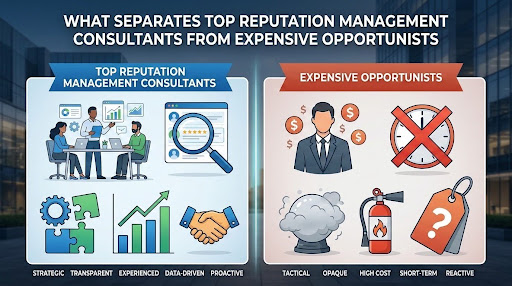
Top reputation management consultants build their practice around documented results, not urgency-driven sales tactics. When a brand crisis hits, the pressure to hire someone fast opens the door to providers who collect big retainers and deliver little. Knowing the operational differences between the two groups protects both your budget and your brand.
The split shows up across five areas: diagnostic depth, contract structure, reporting cadence, tool investment, and outcome guarantees. Each one tells you something concrete about how a consultant actually works.
Diagnostic Process Depth
A thorough reputation audit takes time. Consultants who do the work right conduct comprehensive 72-hour audits that cover every digital touchpoint and stakeholder interaction before making any recommendations.
Opportunists skip this step. Their “assessment” is often a 2-hour sales call built to close a contract, not diagnose a problem. If a provider is ready to sign you before they understand your situation, that’s a signal worth noting.
Contract Structure and Payment Terms
Contract structure reveals how much accountability a consultant is willing to accept. Established firms tie payments to performance milestones, so the consultant is paid only as results materialize.
Opportunists tend to ask for large upfront deposits, sometimes 50 percent of the total fee, before any work begins. Once that money changes hands, your leverage to demand results drops sharply.
Reporting Cadence and Tool Investment
How often you hear from your consultant and what data they show you says a lot about their process. Reputable consultants deliver biweekly sentiment scorecards that track perception shifts across platforms and audience segments.
Opportunists typically send a monthly PDF with surface-level numbers and no trend analysis. That cadence is too slow to catch a problem before it grows.
Tool investment follows the same pattern. Professional firms use proprietary sentiment analysis platforms built to catch nuance and context. Opportunists often rely on free Google Alerts, which miss subtler threats and don’t cover specialized platforms where reputation damage frequently starts.
Proven Track Record
A documented track record is one of the clearest ways to separate real expertise from marketing polish. Consultants worth hiring maintain verifiable case studies, often showing measurable sentiment improvement over a defined engagement period, and they back those numbers with reporting you can actually review.
Opportunists tend to rely on confident presentations rather than evidence. They’ll talk about frameworks and philosophy while staying vague on actual outcomes for past clients. Asking direct questions about past results and requesting documentation are among the fastest ways to test whether a provider can back up what they’re saying.
What Case Studies Should Show You
A real case study includes a starting baseline, the specific actions taken, the budget involved, the timeline, and a measurable end result. If any of those pieces are missing, you’re looking at a testimonial dressed up as a case study, not actual proof of work.
For example, an executive reputation case that suppresses a set number of negative articles across search results within nine months, using documented content strategies and platform partnerships, gives you something to verify. A vague claim of “improved online presence” doesn’t.
Transparent Methodology
Methodology transparency is a defining trait of ethical reputation management. Consultants who operate above board publish their process step by step, including how algorithm factors and ranking signals are weighted in their approach.
This openness lets you verify compliance with search engine guidelines before you sign anything. When a provider shares their framework freely, sentiment analysis, brand monitoring, and review velocity tracking stop being mysterious black boxes and become things you can actually evaluate. Companies like NetReputation have published breakdowns of how their monitoring and content strategies work, which is the kind of disclosure clients should expect as standard, not as a bonus.
Competitive analysis and stakeholder mapping should also show up in that documentation. If a consultant can’t explain how they arrived at a recommendation, that’s a gap worth questioning before you commit a budget.
Ethics and Disclosure
Ethical disclosure is the practice of a consultant openly stating which tools, platforms, and tactics they use, and which ones they refuse to use. This matters because the generation of fake reviews is prohibited under FTC regulations, and firms that engage in it expose clients to regulatory risk and reputational damage.
Four disclosure practices separate responsible consultants from risky ones:
- Written confirmation that no fake reviews will be created or purchased
- Quarterly transparency reports listing every platform and vendor involved
- Client education sessions that explain only algorithm-compliant tactics
- Contract clauses allowing immediate termination if undisclosed black-hat methods surface
These protections exist because regulators have taken action against agencies using deceptive reputation tactics in recent years. A consultant who welcomes this level of scrutiny is signaling confidence in their own process.
Strategic vs Tactical Focus
The difference between a strategic consultant and a tactical provider comes down to where they spend their time. Strategic consultants put the bulk of their hours into perception gap analysis and narrative control mapping. Tactical providers spend most of their time on daily review, monitoring, and reactive tasks.
| Focus area | Strategic consultant | Tactical provider | Typical engagement length |
| Perception mapping | High allocation | Minimal allocation | Long-term |
| Review management | Low allocation | High allocation | Short-term |
| Content strategy | High allocation | Moderate allocation | Long-term |
| Crisis planning | Included | Rarely included | Long-term |
Strategic engagements tend to run much longer, often well beyond a year, because building durable change in perception takes sustained work. Tactical engagements wrap up faster but usually require renewal because the underlying issues were never addressed, only managed week to week.
Neither approach is inherently wrong. A short-term reactive engagement makes sense during an acute crisis. The problem arises when a consultant sells tactical-level work at strategic-level pricing and with strategic-level promises.
Client-Centric Approach
A client-centric reputation consultant invests real time upfront to understand the organization before proposing solutions. That typically means stakeholder mapping sessions involving leadership, legal, and customer service, not a templated questionnaire.
Communication structure matters too. Regular strategy calls with a small group of stakeholders keep decisions moving rather than getting lost in a large committee. Custom dashboards showing real-time sentiment trends, along with periodic training sessions for the client’s internal team, are signs the consultant wants the client to understand the work, not just receive a bill for it.
A defined post-engagement support window is another marker of a client-first approach. It signals the consultant expects the relationship to end on a stable footing rather than create ongoing dependency.
Measurement and Accountability
Measurement and accountability mean a consultant defines specific, trackable KPIs before work begins and reports against them consistently. The reason this matters is straightforward: without a baseline, there’s no way to prove an engagement actually moved the needle.
Solid measurement frameworks typically include weekly sentiment tracking across major review platforms, monthly SERP position tracking for target keywords, and periodic brand equity surveys gathering direct customer feedback. Real-time review velocity monitoring catches unusual activity early, whether that’s a sudden spike in negative reviews or an emerging crisis.
Written performance guarantees that tie fees to specific benchmarks, with provisions if targets are missed, create real accountability. Verbal promises don’t hold up when results fall short. A contract should.
Long-Term Value Creation
The reason long-term value matters more than short-term wins is that reputation work compounds. Consultants focused on lasting impact, transfer monitoring tools, and internal training to the client’s team, rather than keeping the client dependent on ongoing service fees.
Three practices tend to show up consistently in firms built for long-term value:
- Custom brand monitoring portals that get handed over to the client, not retained by the agency
- Quarterly crisis communication playbook updates that reflect current platform policies
- Annual algorithm compliance audits addressing search engine content quality standards
Executive thought leadership positioning, built through media placements and contributor networks, rounds out this approach by building credibility that outlasts any single campaign.
Industry Expertise and Credentials
Verifiable credentials are among the easiest things to verify before signing a contract. Active membership in recognized public relations organizations, documented platform partnerships, and published research in trade publications all point to a consultant operating in the open.
Speaking engagements at industry conferences and platform certifications listed on a company’s team page add another layer of verification. None of these credentials guarantees good work on their own, but their absence, combined with vague answers about methodology, is worth treating as a warning sign.
Network and Resources
A consultant’s network determines how fast they can act when something needs fixing. Established firms maintain direct partnerships with legal teams for defamation and right-of-publicity cases, monitoring platforms for real-time data collection, and media contacts for rapid outreach when accurate information needs to be placed quickly.
These relationships should be verifiable through documented agreements, not just claimed in a sales pitch. A consultant who can’t point to active partnerships, current platform access, or a working journalist list is likely promising capabilities they don’t actually have.
Red Flags of Opportunists
Red flags tend to cluster around the same behaviors. Recognizing them early saves significant time and money.
- Requesting 50 percent or more upfront with no methodology documentation
- Using vague deliverables like “comprehensive reputation overhaul” with no defined benchmarks
- Refusing to provide two or three verifiable client references with contact information
- Claiming proprietary relationships with search engines or platforms without supporting documentation
- Restricting client access to monitoring dashboards through contract clauses
- Applying upselling pressure within the first thirty days for services not in the original proposal
- Offering no written performance guarantees or fee adjustments tied to missed benchmarks
Any one of these, on its own, might provide an explanation. Several appearing together is a clear sign to look elsewhere.
The fastest way to evaluate a potential reputation management partner is to ask for documentation at every step: methodology, past results, contract terms, and references. Consultants confident in their work hand that information over without hesitation. Those relying on urgency and vague promises usually can’t.
