



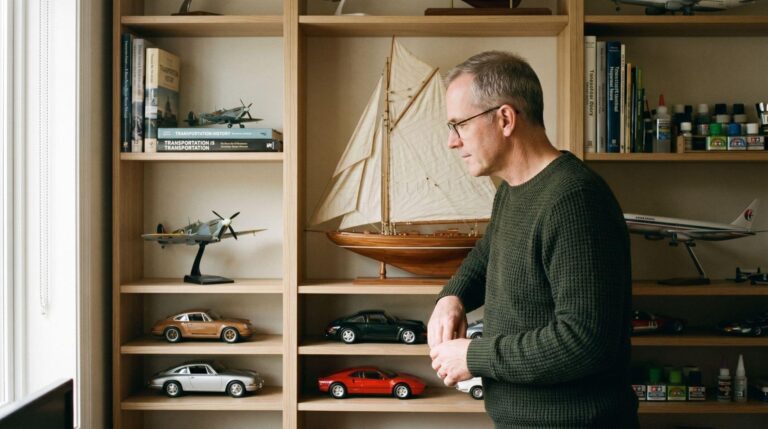
Most things people acquire eventually move on — to a drawer, a storage box, a charity shop, or simply the next house move that prompts the overdue question of whether this object still belongs in the life being lived. The objects that survive that question across decades tend to share one quality: they were chosen with genuine knowledge of what they represent rather than with convenience or impulse.
They are specific rather than generic, personal rather than aspirational, and meaningful in a way that holds up under the scrutiny of years rather than dissolving under it. Scale models — of cars, aircraft, ships, and the other machines that carry cultural and biographical weight — are among the most consistent survivors of that question. And understanding why reveals something important about what serious collecting is actually for.
Why Scale Models Outlast Almost Everything Else People Own
The collecting market is full of objects that enter a room with great ceremony and leave it quietly. Limited edition prints. Commemorative items. Branded merchandise from brands whose relevance did not last as long as their marketing suggested it would. These objects share a characteristic: they were chosen for what they signalled at the moment of acquisition rather than for what they contained. The signal fades. The object loses its function. It moves on.
The scale model that earns permanent residency on a shelf does so through a different mechanism entirely. It was chosen not for what it signalled but for what it referenced — a specific vehicle, a specific period, a specific relationship between the collector and the machine being represented. That reference does not fade with time. If anything it deepens — the distance between the present and the moment the vehicle or aircraft being referenced was most alive in the world gives the replica additional weight rather than diminishing it. The Spitfire on the shelf in 2026 carries more historical significance than it did in 1990, not less. The Ferrari 250 GTO replica commissioned twenty years ago is more historically resonant today than it was at the time of commissioning. Scale models appreciate in meaning in a way that most collecting categories cannot match.
The Model Cars That Earn Their Place — and the Ones That Never Do
There is a reliable distinction between the model cars that stay on a collector’s shelf for decades and the ones that quietly disappear within a year of acquisition. The ones that stay were chosen for a reason that remains true over time — a specific vehicle that marked a specific period, a subject whose historical significance genuinely merits permanent documentation, a replica whose accuracy and quality reward continued examination rather than revealing their limits under it. The ones that disappear were chosen without that reason — because the subject was famous, because the price was right, because it was available at a moment of enthusiasm that did not reflect a deeper or more durable interest.
The serious collector who commissions a precisely made model car of a specific vehicle — the correct variant, the correct colour, the correct period configuration — is making a decision of an entirely different quality from the collector who picks the most readily available piece from a catalogue. The commissioned piece exists because of a specific understanding of why this particular vehicle, in this particular form, deserves to be preserved permanently in the space where the collector works or lives. That understanding does not evaporate. It compounds. And the piece that reflects it remains on the shelf not out of inertia but out of continued relevance.
This is also why the most interesting automotive collections are rarely the most prestigious ones. The collection that documents the vehicles that genuinely shaped the collector’s relationship with cars — the first car they saved for, the family car whose back seat carries the most specific childhood memories, the performance vehicle that defined what driving felt like during the decade when driving mattered most — is more cohesive, more personal, and more likely to hold its meaning over time than the collection that simply maps the canonical subjects of automotive collecting history. The prestigious subject and the personally significant subject are occasionally the same. When they are not, the personally significant one belongs on the shelf and the prestigious one belongs in someone else’s collection.
Airplane Models and the Specific Weight of Sustained Admiration
Aviation collecting operates with a specific emotional logic that automotive collecting shares in part but does not fully replicate. The car is a machine that most collectors have operated directly — driven, owned, maintained, and formed a daily relationship with across years of use. The aircraft is almost always a machine that the collector has not operated — that they have admired from a distance, studied in literature and photography, or experienced as a passenger rather than an operator. The airplane models on a collector’s shelf represent a different relationship with the subject — not biography but sustained and informed admiration. And sustained admiration, when it is genuine and well-founded, produces collecting decisions of the same quality as biographical connection. The collector who has spent twenty years studying the Supermarine Spitfire’s design history knows it as intimately, in their own way, as the pilot who flew it. The replica that reflects that knowledge carries the same weight of understanding.
What distinguishes genuine admiration from passing enthusiasm is the test of time applied with honesty. The collector who was passionate about a subject five years ago and remains passionate about it today — who can provide more specific reasons for their interest now than they could at the beginning, whose knowledge of the subject has grown in proportion with their engagement with it — has genuine admiration. The subject they collect will stay on the shelf. The collector who was enthusiastic about a subject and finds the enthusiasm has not held up under the scrutiny of years should move the piece on. Scale models are honest objects. They do not pretend to be more significant than the reason for their presence. The collection that reflects genuine and sustained interest reads differently from one assembled in bursts of enthusiasm — and the difference is immediately legible to anyone who knows what they are looking at.
The scale model that earns its place stays because of what it references — not what it signalled at the moment of acquisition. That distinction separates the collections worth building from the ones worth dismantling.
What the Best Scale Model Collections Always Have in Common
The most coherent and most personally significant scale model collections — the ones that read as curated arguments rather than accumulated objects — share three qualities regardless of their category, subject range, or price point. The first is subject specificity: every piece was chosen for a reason that remains articulable, not for general category membership. The second is quality consistency: the standard applied to one piece in the collection is applied to all of them, so the display reads as a unified whole rather than a series of compromises at different price points. The third is restraint: the collection contains what belongs and has not accumulated what does not. Restraint in collecting is the hardest quality to maintain and the most visible when it is present.
Restraint is also what separates collecting from accumulating. The collector who adds a piece because it fits the collection’s argument — because it fills a genuine gap in what the display is saying, or because it represents a subject whose significance has been apparent to this collector for years — is curating. The collector who adds a piece because it was available and the price was reasonable is accumulating. Both activities produce objects on shelves. Only one produces a collection. The quality of the model cars and aircraft replicas in a curated collection is higher on average than in an accumulated one — not because the curator has more money to spend but because they acquire less frequently and choose more carefully. The budget spent on three well-chosen pieces consistently produces a better collection than the same budget spread across twelve adequate ones.
The Commissioned Piece — When the Catalogue Cannot Supply What the Collection Needs
The most personally significant pieces in any serious collection are almost always the ones that required a commission rather than a catalogue purchase. Not because commissioning is inherently superior to buying a finished production piece — quality production pieces are legitimate and valuable collecting objects — but because the decision to commission reflects a level of subject specificity that the production catalogue cannot accommodate. The production catalogue supplies what the market wants generically. The commission supplies what one specific collector needs precisely.
The collector who identifies a subject so specific — a particular vehicle in a particular colour from a particular year that the production market has not tooled and never will — and commissions its replica from a specialist maker is exercising the highest form of collecting judgement. They have identified a gap in what exists, determined that the gap matters, and invested in filling it correctly. The piece that results is, by definition, available to no other collection. It exists because of this collector’s specific knowledge and specific decision. That singularity is the most durable value any collecting object can carry — and it is available only through commission, never through catalogue.
Frequently Asked Questions
What makes a scale model collection worth keeping long term?
The scale model collections that endure are built on subject specificity rather than general enthusiasm. Each piece was chosen for a reason that remains true over time — a vehicle that marked a specific period, a subject whose historical significance merits permanent documentation, a replica whose accuracy rewards continued examination. Collections assembled from genuine and sustained knowledge of the subjects they represent hold their coherence and their meaning across decades in a way that collections assembled from enthusiasm alone do not.
When is it worth commissioning a scale model rather than buying ready-made?
Commission is worth pursuing when the subject the collector requires does not exist in the production catalogue — because it is too specific, too uncommon, or too personally significant to accept the accuracy compromises that production pieces make. A specific vehicle in a non-standard colour, a named aircraft in a period livery no longer available, a commercially insignificant type whose collecting significance is entirely personal — all of these justify commission over catalogue. The result is a piece that exists for one collection and could not be found in any other.
Do model cars and airplane models hold their value over time?
Quality scale models from reputable producers and specialist commissions hold their display value well over time — the material quality of a well-made piece does not degrade in the way that lower-quality production items do. Beyond display value, the subjects that represent genuine historical significance or personal specificity appreciate in meaning as the distance between the present and the subject’s era grows. The collecting value of a 1960s Ferrari replica or a WW2 fighter reproduction is not diminished by time — it is deepened by it. The investment in quality at the point of acquisition protects both the physical piece and its significance.
The Collection That Outlasts the Enthusiasm That Built It
The best scale model collections are not the products of enthusiasm alone. They are the products of sustained, specific knowledge applied with restraint to the question of which objects deserve permanent presence in the spaces where the collector lives and works. Enthusiasm starts the collection. Knowledge sustains it. Restraint gives it coherence. And the pieces that result from that combination — the precisely made model car of the specific vehicle that mattered, the aircraft replica in the specific livery that the collector has studied for twenty years, the commissioned piece that exists nowhere else — are the objects that outlast the enthusiasm that prompted them and earn their place on the shelf across everything that follows.
That is what serious collecting is for. Not accumulation. Not display. The permanent and three-dimensional record of what mattered — chosen carefully, acquired correctly, and kept with the seriousness the choice deserved.
