



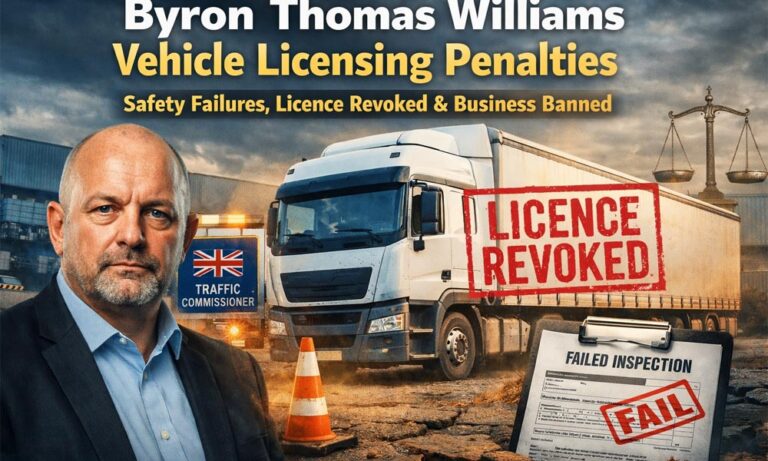
Running a transport company may look simple from the outside. Trucks move, goods get delivered, and business keeps going. But behind the scenes, there are strict rules that must be followed every single day. One small mistake can turn into a big problem very fast.
This is exactly what happened in the Byron Thomas Williams vehicle licensing penalties case. What started as a simple vehicle check soon turned into a serious legal issue. A whole company lost its licence, and its director faced personal penalties.
In this article, we will walk through the full story in a very simple way. You will learn what went wrong, what penalties were given, and what lessons every transport business should learn. Let’s start from the beginning.
Who Is Byron Thomas Williams?
Byron Thomas Williams was a company director in the UK transport industry. He was responsible for running a haulage business called BTW Transport Ltd. This company used trucks and trailers to move goods from one place to another.
Like many transport businesses, BTW Transport needed a special licence to operate. This licence allowed them to legally use heavy vehicles on the road. It also showed that the company was following safety and legal rules.
As a director, Byron Thomas Williams was not just a name on paper. He had a key role in making sure everything was done correctly. This included vehicle safety, proper records, and following all transport laws. When things go wrong, the responsibility often comes back to the director.
What Is Vehicle Licensing and Why It Matters
Before we go deeper into the Byron Thomas Williams vehicle licensing penalties, it’s important to understand what vehicle licensing really means.
In the UK, transport companies must have an operator’s licence. This licence is given by the Traffic Commissioner. It proves that the company is safe, reliable, and able to manage its vehicles properly.
But this licence is not just a one-time approval. Companies must keep following the rules every day. They must:
-
Keep vehicles in good condition
-
Do regular safety checks
-
Maintain proper records
-
Make sure drivers follow safety rules
Why does this matter so much? Because unsafe vehicles can cause serious accidents. Imagine a truck with bad brakes or loose parts on a busy road. That can be very dangerous for drivers and the public.
That’s why these rules are strict. They are not there to make life hard. They are there to keep everyone safe.
Byron Thomas Williams Vehicle Licensing Penalties: How It All Started
The Byron Thomas Williams vehicle licensing penalties case did not start with a big accident. It started with something small.
During a routine inspection, one of the company’s trucks was checked. Inspectors found loose wheel nuts on the vehicle. This might sound like a small issue, but it is actually very serious. Loose wheel nuts can cause wheels to come off while driving.
This small finding raised a big question: If this problem was missed, what else might be wrong?
Because of this concern, authorities decided to take a closer look at the company. What they found next was much bigger than expected. The inspection opened the door to a full investigation into how the company was being run.
Byron Thomas Williams Vehicle Licensing Penalties: Major Safety Problems Found
As the investigation continued, more issues started to appear. These were not just small mistakes. They showed a pattern of poor safety management.
The company’s vehicles were not being maintained properly. Some trucks had issues that should have been fixed earlier. In some cases, brake tests were missing or not recorded. This is a serious problem because brakes are one of the most important safety parts of any vehicle.
Think about it like this: Would you feel safe driving a car if you didn’t know whether the brakes were checked? Most people would say no.
The same applies to heavy trucks, but the risk is even higher. These vehicles are bigger and heavier. If something goes wrong, the damage can be much worse. This is why proper maintenance is not optional—it is a must.
Byron Thomas Williams Vehicle Licensing Penalties: Problems with Records
Another major issue in the Byron Thomas Williams vehicle licensing penalties case was poor record-keeping.
Transport companies must keep clear and correct records. These records show that vehicles are being checked, repaired, and maintained on time. They also help authorities confirm that the company is following the rules.
In this case, the records were not reliable. Some documents were incomplete, while others were simply wrong. There were even cases where records mentioned parts that were not actually installed in the vehicles.
This creates a serious problem. If records cannot be trusted, how can anyone be sure that the vehicles are safe?
It’s a bit like keeping fake medical records. If a doctor writes that a patient is healthy without proper checks, the result can be dangerous. The same idea applies here. Wrong records can hide real problems.
Byron Thomas Williams Vehicle Licensing Penalties: Driver Reporting Issues
Drivers are the first line of safety in any transport company. They use the vehicles every day. They can see and feel if something is wrong.
In a proper system, drivers must report any issues they notice. This is called a defect reporting system. It helps fix problems early before they become serious.
But in this case, something strange was happening.
Drivers were often reporting that there were no defects at all. On paper, everything looked fine. But when inspectors checked the vehicles, they found real problems.
This raised an important question: Were drivers not trained properly, or was the system simply not working?
Either way, this showed a weak safety system. A good company makes sure drivers understand their role. They should feel responsible for reporting every issue, no matter how small.
Byron Thomas Williams Vehicle Licensing Penalties: Operating Without a Licence
Now we come to one of the most serious parts of the Byron Thomas Williams vehicle licensing penalties case.
After all these issues were found, the company’s operator’s licence was revoked. This means they were no longer allowed to operate their vehicles legally.
At this point, most companies would stop immediately and fix their problems.
But that did not happen here.
BTW Transport Ltd. continued to operate its vehicles for about three weeks after losing the licence. This is a major violation of the law.
Operating without a licence is like driving without permission. It shows a clear disregard for the rules. It also puts other road users at risk because the system designed to ensure safety is being ignored.
This decision made the situation much worse and led to even stronger penalties.
Byron Thomas Williams Vehicle Licensing Penalties: Tax and Compliance Failures
The problems in the Byron Thomas Williams vehicle licensing penalties case did not stop at safety and licensing. There were also issues with tax and basic legal compliance.
Some of the company’s vehicles were found to be running without proper vehicle tax (VED). This may sound like a small detail, but it is very important. Every legal transport company must pay this tax to use vehicles on public roads.
When a company avoids paying tax, it gains an unfair advantage. Other companies follow the rules and pay their fees. But in this case, BTW Transport was cutting corners. This not only broke the law but also damaged trust in the business.
Think about it like this. If one business follows all the rules and another ignores them, the playing field becomes unfair. This is why regulators take tax and compliance issues very seriously.
The Public Inquiry and Final Decision
After all these issues came to light, the authorities decided to take formal action. A public inquiry was called by the Traffic Commissioner.
A public inquiry is like a formal review. It looks at all the facts and decides if a company is fit to keep operating. In this case, the inquiry carefully reviewed safety records, maintenance systems, and company behavior.
During the inquiry, it became clear that the company had many weaknesses. The systems in place were not strong enough. There was little confidence that the company could fix its problems quickly.
Because of this, the Traffic Commissioner made a strong decision. The company was no longer trusted to operate safely on the roads.
Byron Thomas Williams Vehicle Licensing Penalties: Final Punishments
The final outcome of the Byron Thomas Williams vehicle licensing penalties case was very serious.
First, the company’s operator’s licence was fully revoked. This means BTW Transport Ltd. could no longer run its vehicles legally at all. The business operations had to stop.
On top of that, the company was given a 12-month ban. During this time, they were not allowed to apply for a new licence. This is a big blow for any transport business.
Imagine building a company over many years and then losing the right to operate. This shows how serious these rules are. Once trust is lost, it is very hard to get it back.
Personal Penalties for Byron Thomas Williams
The penalties were not just for the company. Byron Thomas Williams himself also faced serious consequences.
He was disqualified for 12 months from holding or being involved in any operator’s licence. This means he could not run or manage a transport business during that time.
This part of the Byron Thomas Williams vehicle licensing penalties case is very important. It shows that leaders are personally responsible for what happens in their companies.
Running a business is not just about making money. It is also about following rules and keeping people safe. When a director fails in this duty, the law can hold them personally accountable.
What Happened to the Transport Manager
The transport manager also faced serious consequences in this case.
A transport manager plays a key role in any haulage company. They are responsible for vehicle safety, maintenance schedules, and driver compliance. In simple words, they help keep everything running safely and legally.
In this case, the transport manager lost their good repute. This is a formal term used in the industry. It means they are no longer trusted to do the job properly.
As a result, they were disqualified from acting as a transport manager. This can have a big impact on a person’s career. It shows how important this role is and how seriously it is taken.
Big Lessons from Byron Thomas Williams Vehicle Licensing Penalties
There are many important lessons we can learn from the Byron Thomas Williams vehicle licensing penalties case.
First, safety should always come first. Vehicles must be checked regularly. Small issues, like loose parts, should never be ignored. One small mistake can lead to a big problem.
Second, records must be clear and honest. Paperwork is not just for show. It proves that the company is doing things the right way. False or missing records can destroy trust.
Third, companies must respect the law. Operating without a licence or skipping tax payments will always lead to serious trouble. These are not small rules. They are the foundation of the whole system.
How Companies Can Avoid Vehicle Licensing Penalties
The good news is that these problems can be avoided with the right steps.
Companies should build strong maintenance systems. This means checking vehicles on time and fixing issues quickly. A simple checklist can make a big difference.
They should also train drivers properly. Drivers should feel responsible for reporting any problem. Even a small sound or warning sign should be reported.
Another important step is keeping clear and correct records. Everything should be written down properly. This helps both the company and the authorities trust the system.
Finally, always follow legal rules. Pay taxes on time. Respect licence conditions. If something goes wrong, fix it before it becomes a bigger issue.
Why This Case Still Matters Today
Even in 2026, the Byron Thomas Williams vehicle licensing penalties case is still important.
It is often used as a real example of what can go wrong in the transport industry. Many new companies learn from this case when they start their operations.
It also reminds people that rules are there for a reason. They protect drivers, businesses, and the public. Ignoring them can lead to serious damage, not just financially but also in reputation.
This case is a strong warning. It shows that success in transport is not just about moving goods. It is about doing things the right way every day.
Conclusion
The story of Byron Thomas Williams vehicle licensing penalties is a powerful lesson for every transport company.
It started with small issues, like loose wheel nuts, but quickly turned into a major legal problem. Poor maintenance, weak systems, and ignoring rules all played a part.
In the end, the company lost its licence, the director faced personal penalties, and the transport manager lost their position. These are serious outcomes that could have been avoided.
The message is simple. Follow the rules, keep your vehicles safe, and stay honest in your work. When you do that, you protect your business, your team, and everyone on the road.
(FAQs)
What happened in the Byron Thomas Williams vehicle licensing penalties case?
The case involved a UK transport company, BTW Transport Ltd., that failed to follow important safety and licensing rules. Problems like poor vehicle maintenance, wrong records, and illegal operations led to serious action. In the end, the company lost its licence, and both the director and transport manager faced penalties.
Why were Byron Thomas Williams vehicle licensing penalties so serious?
The penalties were serious because the company put safety at risk. Vehicles were not properly checked, and the company continued working without a licence. These actions broke major laws and could have caused dangerous accidents on the road.
What is an operator’s licence in the UK transport industry?
An operator’s licence is a legal permit that allows companies to run heavy goods vehicles. It shows that the company meets safety, financial, and management standards. Without this licence, a company cannot legally operate its trucks.
What safety problems were found in this case?
Inspectors found many issues, including loose wheel nuts, missing brake tests, and poorly maintained vehicles. These problems showed that the company was not taking vehicle safety seriously, which increased the risk of accidents.
Did the company really operate without a valid licence?
Yes, and this was one of the most shocking parts of the case. BTW Transport Ltd. continued operating for about three weeks after its licence was revoked. This is a major legal violation and made the penalties much worse.
What penalties did Byron Thomas Williams face personally?
Byron Thomas Williams was disqualified for 12 months from holding or being involved in any operator’s licence. This means he could not run or manage a transport business during that period.
What happened to the transport manager in this case?
The transport manager lost their “good repute,” which means they were no longer trusted to do their job properly. They were disqualified from working as a transport manager, which can seriously affect their career.
Why are maintenance records so important in transport businesses?
Maintenance records prove that vehicles are safe and properly checked. In this case, records were incomplete or false, which made regulators lose trust. Good records help prevent accidents and show that a company is following the rules.
How can companies avoid vehicle licensing penalties like this?
Companies can avoid these problems by keeping vehicles well maintained, training drivers properly, keeping clear records, and following all legal rules. Regular checks and honest reporting can prevent small issues from becoming big problems.
What is the biggest lesson from the Byron Thomas Williams vehicle licensing penalties case?
The biggest lesson is simple: always follow the rules and prioritize safety. Ignoring small issues, skipping checks, or breaking laws can lead to serious consequences. A strong system and honest work can protect both the business and the public.
You may also read: Enerstor: The Smart Way to Store and Use Energy in 2026
