



There is a specific kind of buyer who comes to OrcaRouter looking at the DeepSeek V4 Pro vs MiniMax M2.7 highspeed page, and it is not someone shopping for the smartest model in the world. It is someone who has already decided the task is mechanical — extraction, tagging, bulk rewriting, log triage — and now needs the cheapest thing that will reliably do it. This pair is the bottom of our price table, and the interesting thing about it is that the two cards do not agree on which one is cheaper.
Two cards that disagree about what “cheap” means
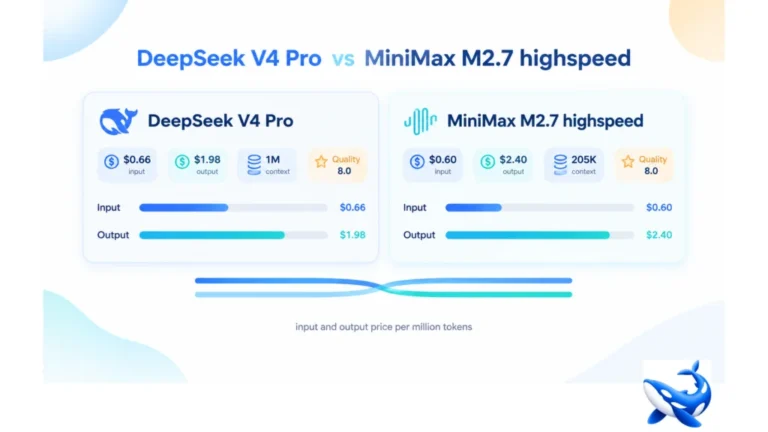
Both endpoints sit below a dollar per million input tokens, which is the cheapest neighbourhood on the board. Read on 2026-10-13:
| metric | DeepSeek V4 Pro | MiniMax M2.7 highspeed | winner |
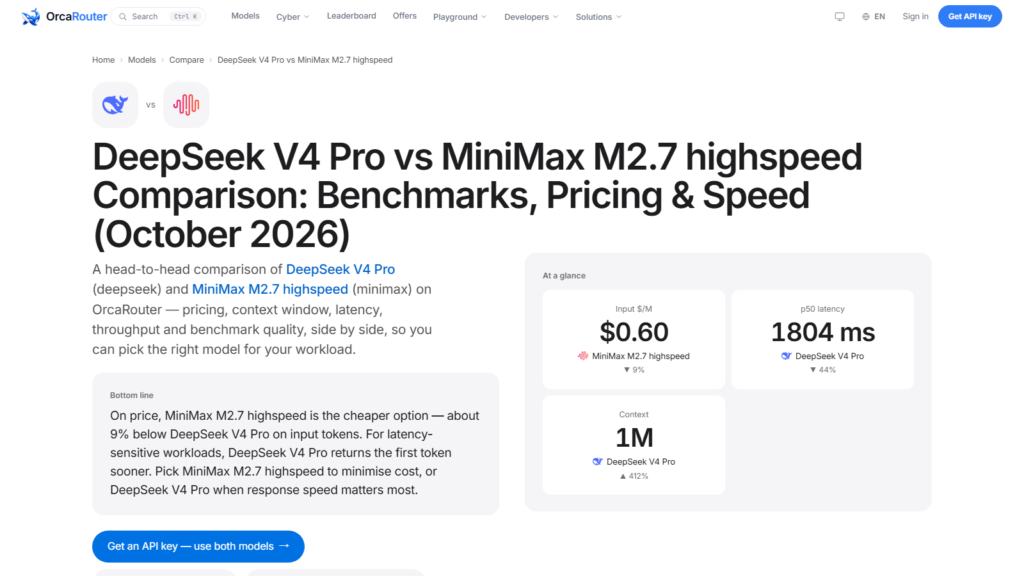
| input, per million tokens | $0.66 | $0.60 | MiniMax, by about 9% |
| output, per million tokens | $1.98 | $2.40 | DeepSeek, by about 18% |
| output-to-input multiple | 3.0x | 4.0x | DeepSeek, the flattest multiple on the board |
| context window | 1M | 205K | DeepSeek, roughly five times larger |
| composite quality, 0–10 | 8.0 | 8.0 | tie |
The reversal is the whole story. MiniMax M2.7 highspeed is the cheaper place to put your input tokens and the more expensive place to put your output tokens, and the gap on the output side is twice the gap on the input side. A card that looks 9% cheaper on the headline number is 18% more expensive on the line that grows fastest in most pipelines.
Why the mix decides this, not the headline price
Take a workload and push it through both pricing shapes. At one million input tokens and a hundred thousand output tokens — a heavy read, light write job, which is what classification and extraction look like — MiniMax costs $0.60 plus $0.24, and DeepSeek costs $0.66 plus $0.198. MiniMax wins by roughly four cents per million input tokens. Turn the workload around: a hundred thousand input tokens and one million output tokens, which is what a long-form generation job looks like, and MiniMax costs $0.06 plus $2.40 while DeepSeek costs $0.066 plus $1.98. DeepSeek wins by about forty-two cents.
That crossover is the only real decision on this page. Both models score 8.0 on our composite quality scale, so neither side buys you capability — the choice is entirely about which line on your invoice grows faster. If your average call reads far more than it writes, take MiniMax. If it writes more than it reads, or if the two are close to balanced, take DeepSeek and stop thinking about it.
The composite quality tie, and what it does and does not mean
An 8.0 on both sides is the lowest score in the twelve-model set we price, and it is worth being plain about what that number is. It is our own composite: a 0–10 figure we compute from four evaluation families we run against each endpoint — reasoning, code generation, long-context retrieval and instruction following — averaged together. It is not a third-party leaderboard and it is not a reproducible benchmark on someone else’s harness.
The reason to be careful with a tie at the bottom of the range is that a composite averages away the shape of a model’s weaknesses. Two models that both average 8.0 can fail on entirely different inputs. If your workload is narrow — one task, one output schema, one failure mode you care about — a composite that flattens four evaluation families tells you less than a day of running your own traces through both endpoints. The tie is a statement about the average, not about your specific task.
The context window is the third price
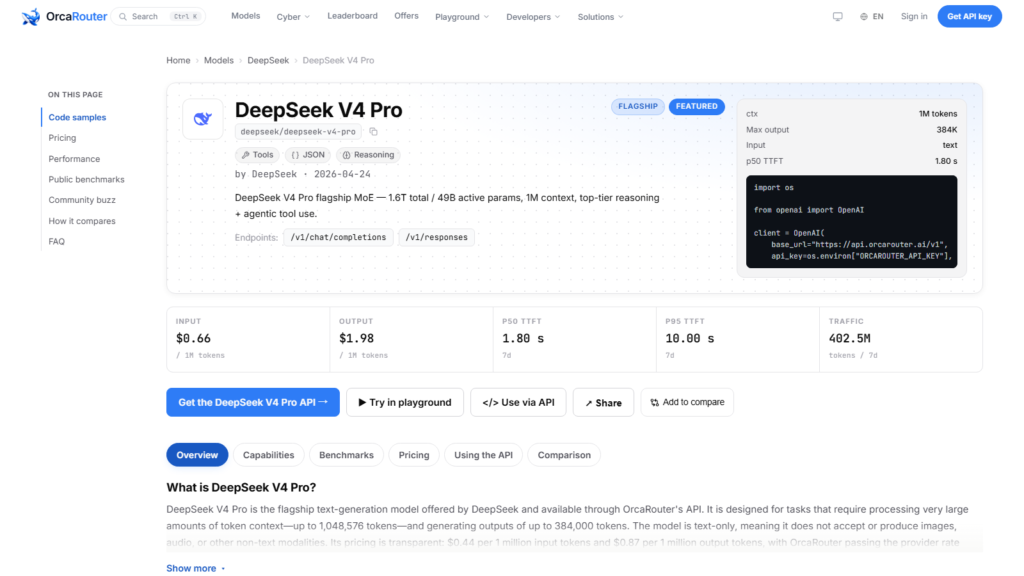
The one place this pair is not close is the context window. DeepSeek V4 Pro carries 1M tokens; MiniMax M2.7 highspeed carries 205K. That is roughly a five-times difference, and it belongs in the cost conversation rather than the capability one, because a context window is really a statement about how much retrieval you can avoid.
If your documents fit inside 205K, the smaller window costs you nothing and MiniMax is a legitimate choice. If they do not, the smaller window does not fail cleanly — it forces you into chunking, and chunking means re-reading overlapping spans, which means paying the input rate more than once for the same text. A model that is 9% cheaper per input token stops being cheaper the moment your pipeline has to read the same document twice to work around a window that will not hold it. In that light, DeepSeek’s 1M window is not a capability feature, it is a discount on the shape of your pipeline.
What the flat multiple is worth
DeepSeek’s output-to-input multiple is 3.0x, the flattest in the twelve-model set — MiniMax bills 4.0x, and the Claude and Gemini flagships go to 5.0x and 6.0x. The multiple is the number that tells you how much a workload’s shape can move your bill, and a flatter multiple means the bill moves less.
For a batch pipeline with unpredictable output lengths, that flatness is worth real money in a way that a per-token discount is not. A 3.0x multiple means the ratio between your cheapest and most expensive call is smaller; you are less exposed to the one job in the batch that decides to write three thousand words when you budgeted for three hundred. If you are sizing a pipeline before you know its output distribution, the flatter card is the safer card, and on this pair the flatter card is also the one with the bigger window.
Running both without committing to either
The reason to evaluate a pair like this on a router rather than on two direct accounts is not a discount, because on a router at list price there is none. It is that the decision here is genuinely a measurement rather than a judgement call. You are not asking which model is smarter; you are asking which of two price shapes matches your token mix, and that is an empirical question you can answer with your own traffic in an afternoon.
Both endpoints sit behind one key on OrcaRouter, so the experiment is a configuration change rather than a second contract — split a slice of your batch, run it through both, and count the tokens rather than guessing at them. Given that the entire difference between these two cards is which line of the invoice grows faster, measuring the mix beats reasoning about it.
The takeaway
DeepSeek V4 Pro and MiniMax M2.7 highspeed both score 8.0 on our composite scale, and both are about as cheap as this board gets. MiniMax is cheaper on input by about 9%; DeepSeek is cheaper on output by about 18% and carries roughly five times the context window with the flattest output multiple we publish. For read-heavy mechanical work inside 205K tokens, MiniMax is the right card. For anything write-heavy, anything with an unpredictable output length, or anything whose documents will not fit in a quarter of a million tokens, DeepSeek is the default and the price difference is small enough that it should not change your mind.
Sourcing note: all prices, context windows and output-to-input multiples were read off our own comparison page for this pair on 2026-10-13. The composite quality column is OrcaRouter’s own 0–10 scale, computed from four evaluation families we run against each endpoint, and is not a third-party index. The comparison page and the model page linked above are OrcaRouter production pages. All checked 2026-10-13.
