



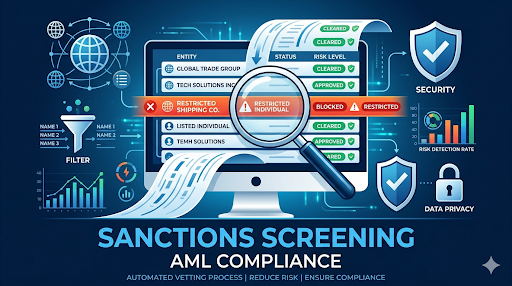
In today’s highly regulated financial environment, organizations must ensure that they do not engage with individuals, entities, or businesses that appear on restricted watchlists. This is where a Sanction Screening System plays a critical role. Financial institutions, fintech companies, payment providers, and other regulated entities rely on advanced screening technologies to identify potential risks and maintain compliance with international regulations.
One of the biggest challenges in compliance screening is accurately matching names across multiple databases and sanctions lists. Variations in spelling, language differences, aliases, and data entry errors can make this process complex. To address these challenges, modern screening solutions use sophisticated name-matching techniques and fuzzy logic algorithms.
Understanding Name Matching in Sanctions Screening
Name matching is the process of comparing customer or transaction data against global watchlists, including the OFAC Sanctions List, United Nations sanctions lists, and other regulatory databases. The objective is to identify potential matches that may indicate a compliance risk.
However, exact name matching alone is often insufficient. Individuals and organizations may have multiple spellings, nicknames, or transliterated versions of their names. For example, a sanctioned individual may appear under different spellings depending on the language or region.
A modern sanction screening tool addresses this challenge by evaluating multiple data points rather than relying solely on exact text matches. This approach helps organizations detect potential risks that could otherwise go unnoticed.
The Role of Fuzzy Logic in Screening
Fuzzy logic is a technology designed to identify records that are similar, even when they are not identical. Instead of looking for perfect matches, fuzzy matching algorithms analyze patterns, character similarities, and phonetic relationships between names.
For example, a screening system may recognize that “Mohammad,” “Muhammad,” and “Mohamed” could refer to the same individual despite spelling differences. This capability significantly improves detection rates and reduces the risk of overlooking sanctioned parties.
Advanced screening platforms use fuzzy logic to compare names across multiple databases and generate match scores. Compliance teams can then review these scores to determine whether a potential match requires further investigation.
Key Techniques Used in Name Matching
Modern compliance platforms utilize several methods to improve screening accuracy:
- Phonetic matching to identify names that sound similar
- Transliteration analysis for names converted between different languages
- Alias and nickname recognition across watchlists
- Character similarity scoring to detect spelling variations
- Context-based matching using additional customer information
These techniques help organizations achieve more reliable screening results while reducing unnecessary alerts.
Why Accuracy Matters in Compliance Programs
False positives remain one of the biggest challenges in compliance operations. When a system generates excessive alerts, compliance teams spend valuable time reviewing records that pose no actual risk. At the same time, false negatives can expose organizations to regulatory penalties and reputational damage.
An effective AML Sanctions Screening program balances sensitivity and precision. By using intelligent matching algorithms, institutions can improve detection capabilities while maintaining operational efficiency.
Many organizations are also concerned about exposure to Secondary Sanctions, which can affect businesses that indirectly engage with sanctioned entities. Accurate screening helps identify these risks before transactions are processed, supporting stronger compliance controls.
Screening Against Global Watchlists
Regulatory requirements continue to evolve, making continuous monitoring essential. Organizations must screen customers, vendors, and transactions against multiple sanctions databases that are updated frequently.
A comprehensive Sanctions Screening process typically includes monitoring against international watchlists, government-issued sanctions programs, politically exposed person databases, and adverse media sources. Automated updates ensure that newly designated individuals or entities are identified promptly.
This level of monitoring is particularly important when screening against the OFAC Sanctions List, one of the most widely referenced sanctions databases used by financial institutions worldwide.
How Technology Improves Screening Efficiency
Modern compliance solutions leverage artificial intelligence, machine learning, and advanced analytics to enhance name matching capabilities. These technologies continuously refine matching models by learning from historical screening outcomes and investigator decisions.
Leading sanction screening providers invest heavily in technology that reduces manual effort while improving risk detection. As regulatory expectations increase, organizations are seeking solutions that provide both accuracy and scalability.
Platforms such as AML Watcher help organizations strengthen compliance operations by offering advanced screening capabilities, comprehensive watchlist coverage, and intelligent matching technology designed to support evolving regulatory requirements.
Conclusion
Effective name matching is the foundation of a reliable Sanction Screening System. Because names can appear in different formats, languages, and spellings, exact matching alone is no longer sufficient. Fuzzy logic and advanced matching techniques enable organizations to identify potential sanctions risks more accurately while reducing unnecessary alerts.
As sanctions regulations continue to expand globally, businesses need screening solutions that can adapt to changing requirements and deliver dependable results. By combining intelligent name matching with robust compliance technology, organizations can strengthen risk management, support regulatory compliance, and improve overall operational efficiency.
