



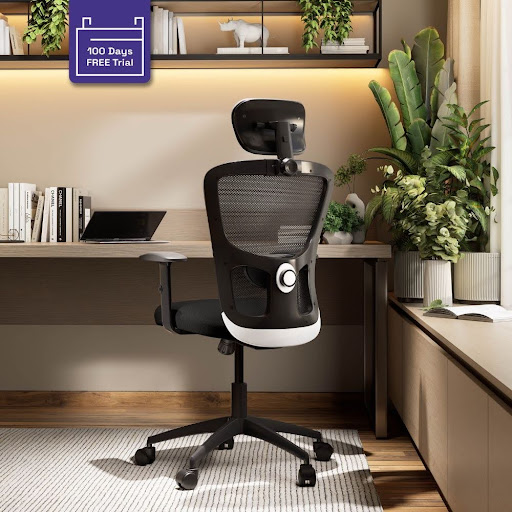
Spending Rs 15,000 on an ergonomic chair and still hunching over at 4 PM is more common than the furniture industry would like you to know – and in most cases, the chair is not to blame. A proper ergonomic chair needs independently adjustable lumbar support, a seat depth slider, and a tilt mechanism that responds to your body weight. This guide covers what to look for before buying, how the price tiers actually break down, and the setup steps most people skip – which is usually where the back pain starts.
Why does your office chair cause back pain after just a few hours?
The spine has a natural S-curve – an inward (lordotic) curve at the lower back and an outward curve at the upper back. Standard chairs tilt the pelvis backward, which flattens the lumbar curve and puts the lower vertebrae under constant compressive load. Over hours, the erector spinae muscles that support the spine fatigue. Discs experience uneven pressure. That familiar 3 PM ache is not about sitting too long – it is about sitting in the wrong geometry.
A 2021 study published in the Indian Journal of Occupational and Environmental Medicine found that 52 percent of full-time WFH employees reported new or worsening back pain within six months of starting remote work. The primary driver was not longer hours. It was the replacement of workplace ergonomic furniture with dining chairs, basic task chairs, or repurposed household seating.
The solution is not a lumbar cushion or a standing desk timer – it is a chair with enough adjustment range to match your actual body proportions.
What features actually matter in an ergonomic chair?
Not every feature on the spec sheet is worth paying for. Here is what delivers real postural benefit versus what gets added for marketing:
| Feature | What It Does | What to Require |
| Lumbar support | Maintains the natural inward curve of the lower back | Adjustable in both height and depth – not a fixed foam pad |
| Seat height | Keeps thighs parallel to floor, feet flat | Gas lift range: 42-52 cm covers most adult heights |
| Seat depth | Prevents pressure at the back of the knee | Sliding seat with at least 2-4 cm range |
| Armrests | Reduces trapezius and shoulder tension during typing | 3D or 4D (height + width + pivot); fixed arms often cause more harm than good |
| Tilt mechanism | Allows weight shifts without losing support | Syncro-tilt with adjustable resistance; avoid free-float only |
| Backrest height | Covers lumbar to mid-shoulder | Minimum 48 cm from seat pan |
| Material | Affects heat buildup and pressure distribution | Mesh back for ventilation; high-density foam seat (40+ kg/m3) |
| Weight rating | Determines gas lift and caster longevity | 100 kg minimum; 120 kg if you are above 90 kg |
The most overrated feature: the headrest. It is only useful if you regularly recline past 15-20 degrees. For upright workers it pushes the chin down and worsens forward head posture.
The most underrated: seat depth adjustment. Anyone under 5’4 or above 6’1 needs this to avoid the front edge of the seat cutting into the back of the knee. It is absent in most chairs under Rs 12,000.
What is the actual difference between an ergonomic chair and a regular office chair?
A regular office chair is a fixed product. An ergonomic chair is an adjustable system. The practical difference is how many independent dimensions you can tune to match your body.
| Parameter | Regular Office Chair | Ergonomic Chair |
| Lumbar support | Fixed or absent | Adjustable height and depth |
| Armrests | Fixed height or removable | 2D to 4D adjustable |
| Seat depth | Fixed | Slider adjustment |
| Tilt control | Basic recline only | Syncro-tilt with resistance settings |
| Seat foam density | Variable, often low | 40+ kg/m3 minimum |
| Weight capacity | 80-90 kg typical | 100-120 kg in quality models |
| Lifespan (daily use) | 2-3 years | 5-8 years |
The financial argument for the upgrade is straightforward. The price gap between a Rs 4,000 task chair and a Rs 18,000 ergonomic chair is Rs 14,000 spread over five years – around Rs 230 per month. A single physiotherapy session in any Indian metro costs more.
How much should you spend on an ergonomic chair in India?
The Indian market runs from Rs 3,000 for basic task chairs to Rs 80,000+ for international premium brands. Here is what each tier genuinely delivers:
| Price Range | What You Actually Get | What Is Missing |
| Under Rs 8,000 | Basic gas lift, thin foam, fixed arms | No lumbar adjustment, foam compresses within a year |
| Rs 8,000-15,000 | Mesh back, adjustable lumbar, 2D armrests | Seat depth control, limited tilt range |
| Rs 15,000-30,000 | Full adjustability, 4D armrests, syncro-tilt, quality foam | Minimal gap between domestic and international brands here |
| Rs 30,000 and above | International brand premium | Marginal ergonomic gain over well-built domestic chairs for home use |
For most WFH professionals and office workers in India, the Rs 15,000-25,000 range from established domestic brands delivers 85-90 percent of the ergonomic benefit. The premium above Rs 30,000 pays for commercial-grade durability designed for multi-shift, multi-user office environments over 10+ years – a valid spend for corporate procurement, rarely justified for a single home user.
Which features should you prioritize when your budget is under Rs 15,000?
If you cannot afford full spec, lumbar adjustability – specifically height adjustment – and a mesh back deliver the most impact for the least cost. Seat depth adjustment is the next priority for anyone below 5’6”. Syncro-tilt with resistance settings is the feature that most commonly disappears below Rs 15,000, and it is an acceptable trade-off if the other three are present. What is not an acceptable trade-off at this price: a fixed lumbar bump on a chair where adjustable lumbar is attainable from domestic brands in the same range.
Weight rating matters at every budget level. Chairs rated to 100 kg from a credible brand have gas lifts and casters specified to that load. Below 100 kg rated capacity, the gas lift piston typically uses lower-grade materials that fail within 12-18 months under full-time daily use. The failure is not dramatic – the chair starts to slowly sink during sessions as the piston seal degrades. This is worth confirming on the spec sheet before buying at any price point, because it determines how long the chair’s functional spec is maintained, not just how it performs on the first day.
At Rs 12,000-15,000, domestic brands have made genuine progress on the core ergonomic spec. The international brand premium at this price in India buys the label, not meaningfully better ergonomics. The engineering difference between a well-built domestic chair at Rs 14,000 and an imported chair at the same price is negligible for a single home user. The domestic brand at this tier is typically the better buy when the alternative is stretching beyond your actual budget to reach a foreign name.
How should you set up an ergonomic chair to actually get the benefit?
Most people adjust the seat height and stop there. That leaves the majority of the chair’s ergonomic range unused.
Seat height first. Sit with both feet flat on the floor. Thighs should be roughly parallel to the ground at a 90-100 degree hip angle. If your feet dangle, add a footrest – do not raise the chair height to compensate.
Lumbar depth next. Slide the lumbar support forward until it makes light contact with the small of your back when sitting upright. It should feel like gentle support – not like it is pushing you forward. If you have to arch to reach it, dial it back.
Seat depth third. Leave 2-3 finger-widths of space between the front edge of the seat and the back of your knee. If the edge presses against your knee, slide the seat backward.
Armrests last. Set them so your elbows rest at 90 degrees with your shoulders relaxed. If your shoulders are elevated, the armrests are too high. If they are too low to support anything, raise them until your shoulders drop naturally.
Then adjust your monitor – not the other way around. Eye level should land at the top third of the screen. Most people do this backward: they fidget with the chair to see the screen better, which undoes every postural adjustment they just made.
A well-built ergonomic chair set up wrong provides no more benefit than the basic chair it replaced.
Across the Indian market, the difference between a chair that helps and one that merely looks the part comes down to how many dimensions of fit it adjusts to. A chair that matches your height, seated depth, lumbar position, and armrest height does different work from one that only moves up and down. Shortlisting from a dedicated range of office chairs with consistent adjustability specs listed across all listings is a faster shortcut than comparing individual product reviews across platforms.
